
1. Introduction
Tata Capital trades near ₹365 as of late June 2026, with a market cap of ₹1,53,340 crore. Investors searching for a 2040 target are really asking one question: can compounding turn this NBFC into a long-term wealth builder?
2. Market Overview
Tata Capital is India’s 3rd largest diversified NBFC, serving 7.3 million customers with a loan book of ₹2.33 lakh crore as of mid-2025.
Q4 FY26 net profit rose 42.82% YoY to ₹1,502.02 crore, while quarterly revenue grew 9.12% YoY to ₹8,160.10 crore. Trailing 12-month operating revenue stands at ₹31,537.53 crore, up 11% annually.
| Metric | Value (as of late June 2026) |
|---|---|
| Current Market Price | ₹363–370 |
| 52-Week Range | ₹296 – ₹379.95 |
| Market Capitalisation | ₹1,53,340 crore |
| P/E Ratio | 31.6x |
| P/B Ratio | 4.46x |
| ROE | ~10% |
| FY26 EPS | ₹11.76 |
3. Key Data Insights
Pre-tax margin stands at a healthy 21%, reflecting disciplined cost control despite competitive lending rates. The FY26 final dividend of ₹0.57 per share signals modest but growing shareholder returns.
The stock trades below its 200-day moving average but close to its 50-day average of ₹328, indicating consolidation after its 2025 listing rally.
| FY26 Financial Snapshot | Figure | YoY Change |
|---|---|---|
| Net Profit (Q4) | ₹1,502.02 crore | +42.82% |
| Revenue (Q4) | ₹8,160.10 crore | +9.12% |
| Operating Revenue (TTM) | ₹31,537.53 crore | +11% |
| Loan Book | ₹2.33 lakh crore | Growing |
4. Investment Strategy (2027–2032 Outlook)
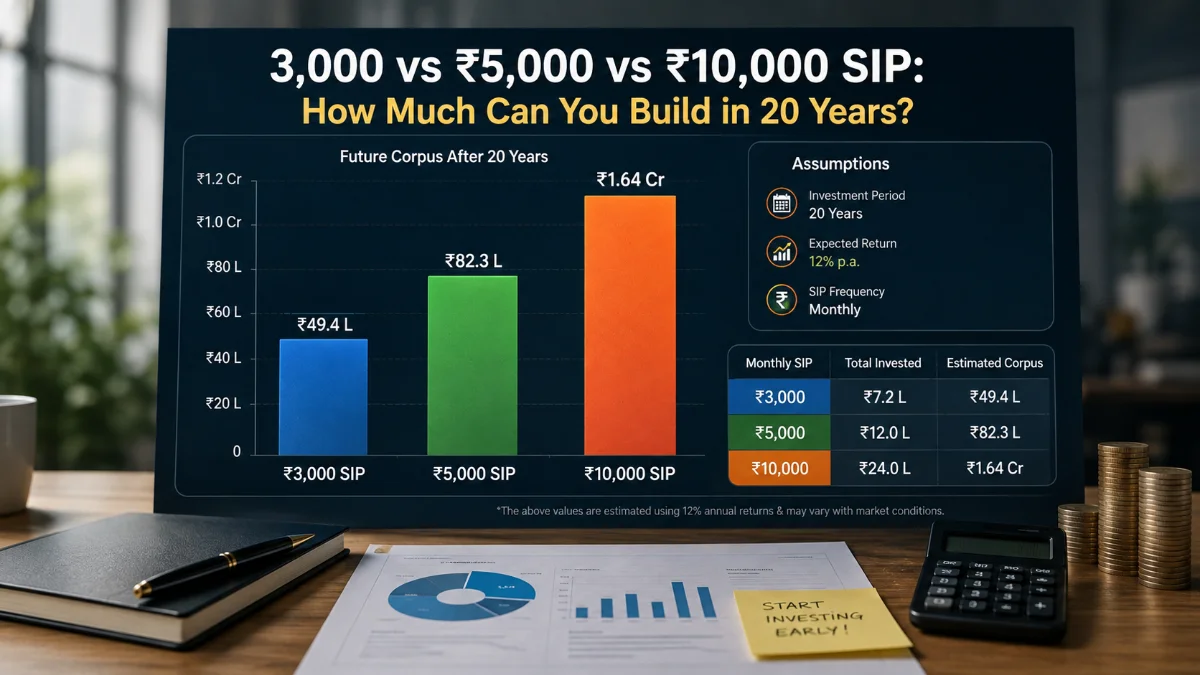
Given the elevated 31.6x PE, a staggered SIP approach reduces valuation-timing risk better than a lumpsum entry at current levels.
Analysts tracking NBFC re-ratings expect affordable housing and unsecured retail loans to remain Tata Capital’s fastest-growing verticals through 2032, supported by India’s projected 6.5–7% GDP growth.
| Approach | Best Suited For | 2027–2032 Rationale |
|---|---|---|
| Monthly SIP | Long-term retail investors | Averages entry across NBFC rate cycles |
| Lumpsum | High-conviction, risk-tolerant investors | Works only if entry aligns with a valuation dip |
| Staggered (Quarterly) | Moderate-risk investors | Balances timing risk and compounding |
5. Growth Forecast: CAGR Scenarios to 2040
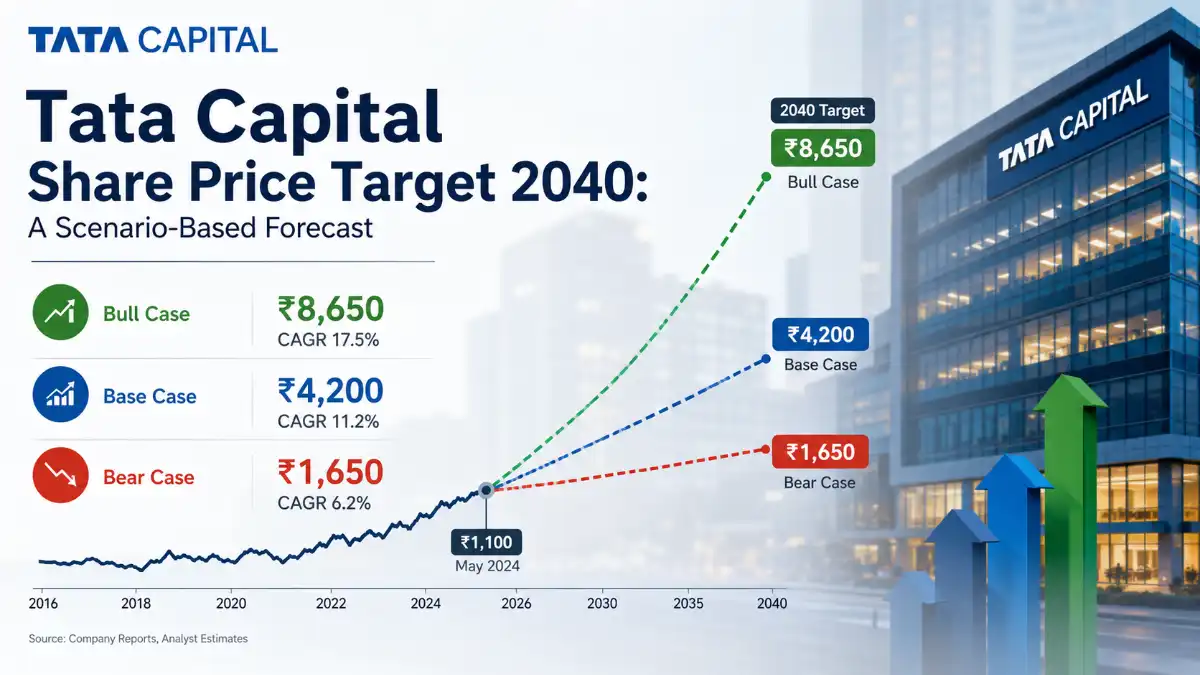
Instead of a fixed 2040 number, three CAGR scenarios illustrate a realistic range, compounded from the current ₹365 base over ~14 years.
| Scenario | Assumed CAGR | Implied Price 2032 | Implied Price 2040 |
|---|---|---|---|
| Conservative | 12% | ~₹805 | ~₹1,995 |
| Base Case | 16% | ~₹1,020 | ~₹3,290 |
| Bull Case | 20% | ~₹1,295 | ~₹5,285 |
These are illustrative compounding models, not price targets or guarantees. Actual returns depend on credit cycles, NBFC regulation, and earnings execution over 14 years — a horizon too long for reliable point forecasts.
| NBFC Sector Segment | Projected Growth (2027–2032) |
|---|---|
| Affordable Housing Finance | 14–17% CAGR |
| Unsecured Personal Loans | 15–18% CAGR |
| SME/Commercial Finance | 11–13% CAGR |
| Wealth Management Services | 16–20% CAGR |
6. Risk Analysis
At 31.6x PE and 4.46x PB, Tata Capital trades at a premium to several NBFC peers, leaving limited room for valuation-multiple expansion.
A ₹413.18 crore income-tax reassessment demand for FY18 (currently contested) and rising NCD-based borrowing—including a recent ₹2,950 crore private placement—add balance-sheet monitoring points.
| Risk Factor | Reward Factor |
|---|---|
| High valuation (31.6x PE) limits near-term upside | Tata Group brand adds trust and lower funding cost |
| NBFC regulatory tightening by RBI | 42.82% YoY profit growth in Q4 FY26 |
| Rising NCD/debt issuance (₹2,950 crore recent) | Diversified book across housing, SME, wealth |
| Unsecured lending asset-quality risk | 7.3 million-customer base with cross-sell potential |
| Investor Risk Profile | Suggested Allocation to Tata Capital |
|---|---|
| Conservative | 3–5% of equity portfolio |
| Moderate | 6–8% of equity portfolio |
| Aggressive | 9–12% of equity portfolio |
7. Conclusion
Tata Capital’s FY26 numbers—42.82% profit growth, a ₹2.33 lakh crore loan book, and 21% pre-tax margins—support a long-term growth thesis, but a 2040 price target remains inherently speculative.
Investors should treat the CAGR scenarios above as planning tools, size positions to their risk profile, and review quarterly earnings rather than anchor decisions to any single long-horizon number.
Frequently Asked Questions
What is the share price target for Tata Capital by 2040?
No credible analyst publishes 14-year targets. Scenario CAGRs of 12–20% on the current ₹365 price imply a wide ₹1,995–₹5,285 range by 2040.
Is Tata Capital a good long-term investment for 2026?
Its 42.82% YoY profit growth and market leadership as India’s 3rd largest NBFC make it worth evaluating for long-term SIP allocation, based on individual risk appetite.
What is Tata Capital’s current PE ratio in 2026?
Around 31.6x as of late June 2026, against a market cap of ₹1,53,340 crore.
What are the biggest risks to Tata Capital’s stock long term?
Regulatory tightening on NBFCs, interest rate cycles, unsecured-loan asset quality, and a premium valuation versus peers.
SEBI Disclaimer: This article is for educational purposes only and is not investment advice. Md Adil and SmartBlog91 are not SEBI-registered investment advisors. Stock market investments are subject to market risk. Price scenarios shown are illustrative compounding models, not forecasts or guarantees. Please consult a SEBI-registered financial advisor before investing.






Artikel bagus! Teks jadi lagu AI: TextSong — /. TextSong