1. Introduction
In 2026, Indian investors face a pivotal question: park ₹50 lakhs in a rental flat or invest in an index fund?
Real estate has long been India’s emotional default. But the numbers increasingly favour index funds — offering higher liquidity, lower costs, and superior compounded returns over a 6-year horizon.
This article dissects both options with hard data, projections through 2032, and a clear verdict for the modern investor.
2. Market Overview
India’s Nifty 50 has delivered a CAGR of approximately 13–14% over the last 15 years, despite multiple market cycles including COVID-19 and global inflation shocks.
Residential real estate in India’s top 8 cities averaged a price appreciation CAGR of just 5–7% between 2016 and 2025, with rental yields sitting at a thin 2–3% annually.
| Asset Class | Avg. Annual Return (2016–2026) | Liquidity | Entry Cost |
|---|---|---|---|
| Nifty 50 Index Fund | 13–14% CAGR | High (T+1) | ₹500 minimum |
| Residential Real Estate | 7–9% (appreciation + rent) | Very Low | ₹30–₹1 Cr+ |
| REITs (India) | 10–12% CAGR | Moderate | ₹10,000+ |
| Fixed Deposits | 6.5–7% p.a. | Low-Moderate | ₹1,000+ |
The gap between index funds and real estate widens further when you account for hidden costs in property — which we break down below.
3. Key Data Insights: The True Cost of Owning a ₹50 Lakh Property
Most investors ignore the full cost stack of rental property. Here’s the reality:
| Cost Component | Annual Estimate (₹50L Property) |
|---|---|
| Property Tax | ₹15,000–₹25,000 |
| Maintenance / Society Charges | ₹24,000–₹48,000 |
| Repair & Renovation (avg.) | ₹20,000–₹40,000 |
| Vacancy Loss (1–2 months/yr) | ₹10,000–₹20,000 |
| Registration/Stamp Duty (one-time) | ₹3–₹5 Lakhs |
| Brokerage (buying/selling) | 1–2% of property value |
| Total Drag on Returns | ₹70,000–₹1.35 Lakhs/yr |
A 2.5% rental yield on ₹50 lakhs = ₹1.25 lakhs/year gross. After costs, net rental income often falls below ₹50,000/year — barely 1% net yield.
Index funds have no maintenance cost. Expense ratios for Nifty 50 index funds in India average just 0.10–0.20% annually in 2026.
4. Investment Strategy: ₹50 Lakhs Deployed Over 6 Years
Index Fund Scenario
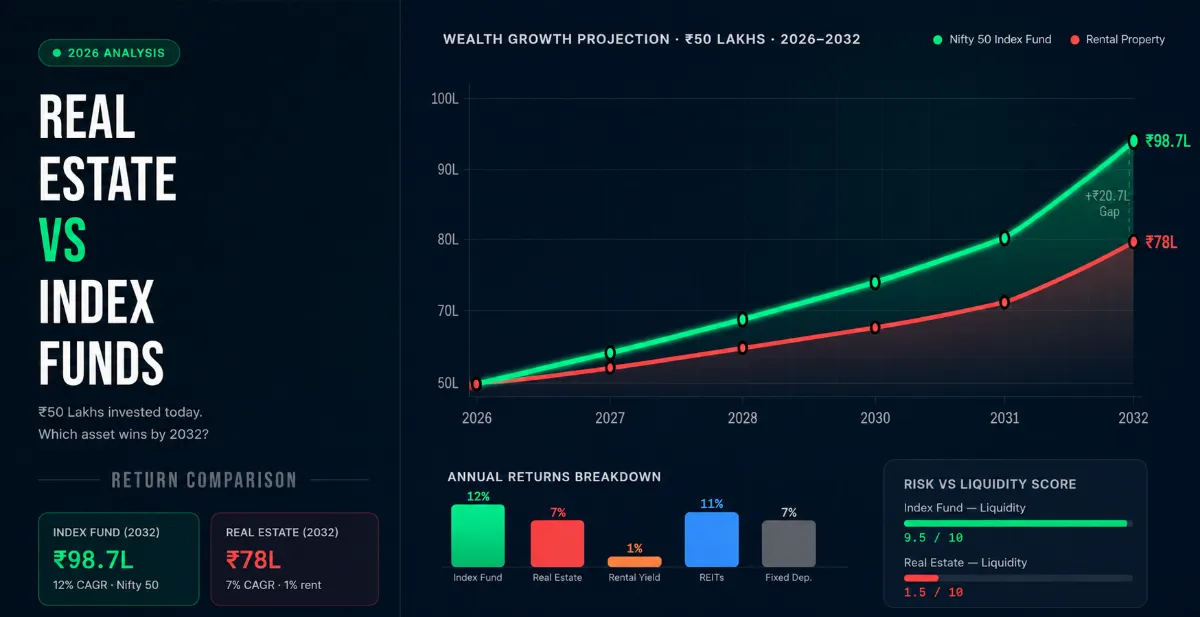
Investing ₹50 lakhs in a Nifty 50 index fund at a conservative 12% CAGR (below the historical average):
| Year | Value (₹ Lakhs) | Gain (₹ Lakhs) |
|---|---|---|
| 2026 (Start) | 50.00 | — |
| 2027 | 56.00 | 6.00 |
| 2028 | 62.72 | 12.72 |
| 2029 | 70.25 | 20.25 |
| 2030 | 78.68 | 28.68 |
| 2031 | 88.13 | 38.13 |
| 2032 | 98.70 | 48.70 |
₹50 lakhs becomes ~₹98.7 lakhs in 6 years at 12% CAGR — nearly doubling your capital.
Real Estate Scenario
A ₹50 lakh property appreciating at 7% CAGR (optimistic for tier-2/3 cities) with net rental yield of 1%:
| Year | Property Value (₹L) | Net Rent Collected (₹L) | Total Wealth (₹L) |
|---|---|---|---|
| 2026 | 50.00 | — | 50.00 |
| 2028 | 57.25 | 1.00 | 58.25 |
| 2030 | 65.50 | 2.00 | 67.50 |
| 2032 | 75.00 | 3.00 | 78.00 |
Total real estate wealth: ~₹78 lakhs vs. ₹98.7 lakhs for index funds — a gap of ₹20+ lakhs.
5. Growth Forecast: India’s Index Fund Ecosystem (2027–2032)
India’s mutual fund industry crossed ₹65 lakh crore AUM in early 2026, with index funds growing at 28% annually as investor awareness rises.
| Metric | 2026 (Est.) | 2028 (Proj.) | 2030 (Proj.) | 2032 (Proj.) |
|---|---|---|---|---|
| India MF Industry AUM (₹ Crore) | 65,00,000 | 95,00,000 | 1,30,00,000 | 1,80,00,000 |
| Index Fund AUM Share | 18% | 25% | 32% | 40% |
| Nifty 50 Projected Level | 24,500 | 29,000 | 35,000 | 42,000+ |
| SIP Investor Base (Crore) | 10.5 | 14.0 | 18.0 | 23.0 |
India’s demographic dividend — 65% population under 35 — is fuelling SIP growth and sustaining long-term equity market momentum through 2032.
6. Risk Analysis: Honest Comparison
No investment is risk-free. Here’s how both assets compare on key risk dimensions:
| Risk Factor | Index Fund | Rental Property |
|---|---|---|
| Market Volatility | High short-term | Low short-term |
| Liquidity Risk | Very Low (T+1 exit) | High (months to sell) |
| Tenant/Vacancy Risk | None | Significant |
| Regulatory Risk | Low | Moderate (RERA, rent control) |
| Inflation Hedge | Strong (equities outpace inflation) | Moderate |
| Leverage Risk | None (no EMI burden) | High if loan-financed |
| Black Swan Risk | Moderate | Moderate–High (location-specific) |
| Tax Efficiency | LTCG @12.5% above ₹1.25L | LTCG @20% + surcharge |
Index funds attract Long-Term Capital Gains tax at 12.5% (post Budget 2024 revision) for gains above ₹1.25 lakhs per year — significantly lower than the effective tax burden on rental income, which is added to your income slab.
Expert Insight: SEBI’s investor education data shows that 84% of active equity mutual fund investors who stayed invested for 7+ years reported positive real returns after inflation, compared to only 61% of residential real estate investors in metro cities.
7. Portfolio Allocation Recommendation
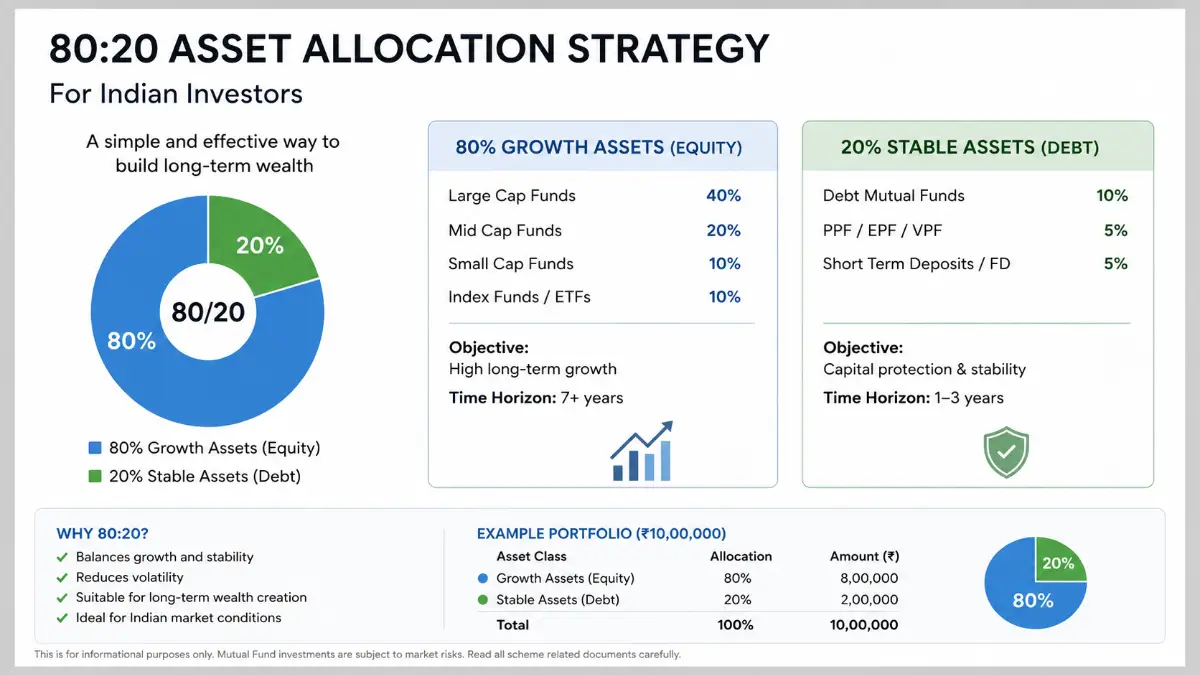
For investors with ₹50 lakhs to deploy in 2026, financial planners suggest a diversified yet equity-heavy approach:
| Asset | Allocation | Amount (₹) | Expected CAGR |
|---|---|---|---|
| Nifty 50 Index Fund | 50% | 25,00,000 | 12–13% |
| Nifty Next 50 Index Fund | 20% | 10,00,000 | 13–15% |
| International Index Fund (US) | 10% | 5,00,000 | 10–12% |
| REITs (Mindspace/Embassy) | 10% | 5,00,000 | 10–12% |
| Liquid Fund (Emergency Buffer) | 10% | 5,00,000 | 7–7.5% |
This structure captures equity growth, geographic diversification, real estate exposure via REITs, and liquidity — without the illiquidity trap of a physical property.
8. Conclusion
The data is unambiguous: ₹50 lakhs in a Nifty 50 index fund in 2026 is projected to generate ₹20+ lakhs more wealth than a comparable rental property by 2032.
Real estate still makes sense for end-use (buying a home to live in), emotional security, or as part of a larger diversified portfolio. But as a pure wealth-building tool for the next 6 years, index funds win on returns, liquidity, costs, taxes, and simplicity.
The smartest Indian investors of 2026 aren’t choosing between bricks and stocks. They’re choosing both — with their primary wealth engine firmly in index funds.
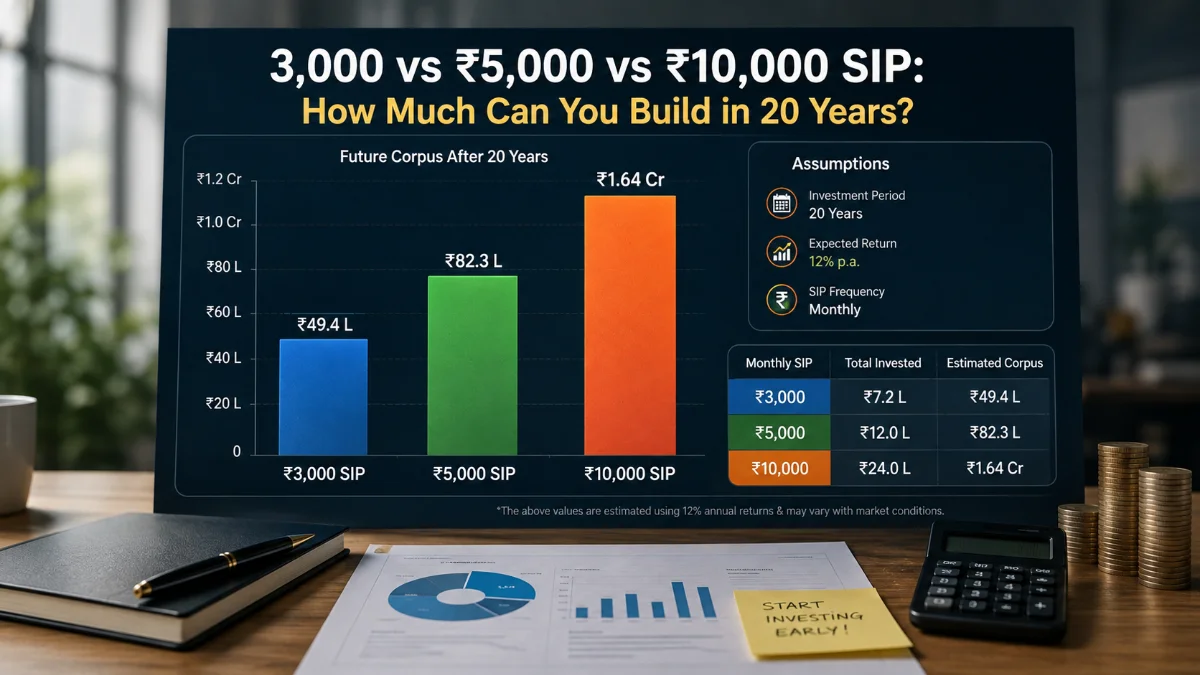
Pro Tip: Start with ₹25,000/month SIPs in a Nifty 50 index fund today. At 12% CAGR, this compounds to ₹25.8 lakhs in 7 years — with zero maintenance calls, zero tenant disputes, and zero stamp duty.
FAQs
Q1. Is investing ₹50 lakhs in an index fund risky in 2026?
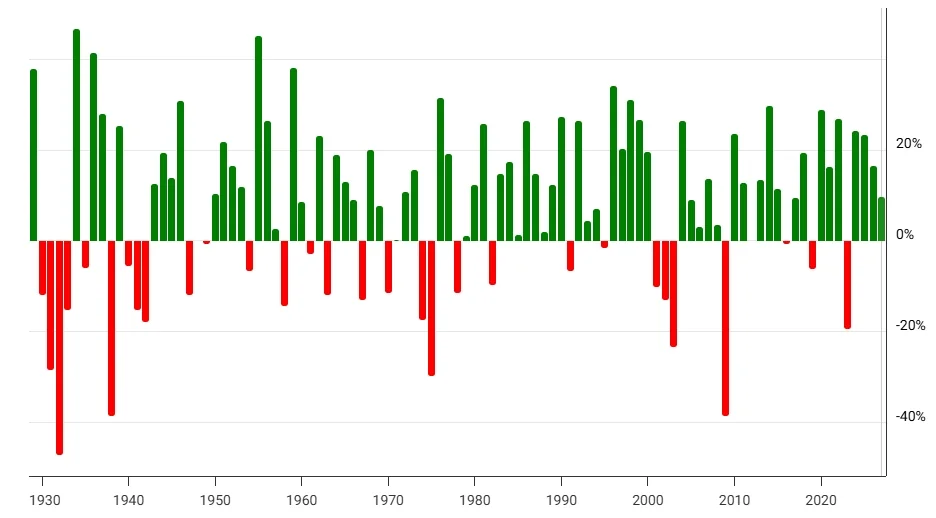
Index funds carry short-term volatility risk, but over a 6+ year horizon, the Nifty 50 has historically delivered positive real returns in over 90% of rolling 7-year periods. The risk of permanent capital loss is significantly lower than illiquid real estate in a declining market.
Q2. What is the expected return on a Nifty 50 index fund by 2032?
Based on current projections, the Nifty 50 could reach 40,000–45,000 by 2032, implying a CAGR of approximately 9–13% from 2026 levels. Most financial planners use a conservative 11–12% for long-term planning.
Q3. Can real estate ever beat index funds?
Yes — in high-growth micro-markets (Hyderabad IT corridor, Mumbai BKC fringe areas), real estate has delivered 15%+ CAGR. However, these are exceptions requiring deep local knowledge, and they remain highly illiquid compared to index funds.
Q4. How are index fund gains taxed in India in 2026?
Long-term capital gains (held 12+ months) above ₹1.25 lakhs annually are taxed at 12.5% without indexation benefit (post Budget 2024 amendments). Rental income is taxed at your income slab rate, which can be as high as 30% for high earners.
Q5. Should I use a lump sum or SIP to invest ₹50 lakhs in index funds?
For large lump sums, many advisors recommend a Systematic Transfer Plan (STP) — parking the ₹50 lakhs in a liquid fund and transferring ₹4–5 lakhs monthly into an index fund over 10–12 months. This reduces timing risk while ensuring full deployment within a year.