
A 1 crore SWP can generate ₹25,000–₹50,000/month – but the rate you pick decides whether your corpus lasts 20 years or grows forever.
TL;DR
A ₹1 crore SWP at 4% per year (₹33,333/month) is genuinely sustainable for most people – the corpus stays flat or grows at a 10% fund return. At 6% (₹50,000/month), you’ll see gradual erosion but the plan can hold for 20+ years. The single biggest mistake is picking the withdrawal amount first and ignoring whether the fund can actually sustain it. Use a balanced advantage fund as your base – it handles market volatility far better than pure equity for this use case – and set up via direct plans on platforms like Groww or Kuvera to avoid eating into your corpus with avoidable expense ratio costs. The tax efficiency over an FD is substantial for anyone in the 20%+ bracket.
What is SWP in mutual funds?
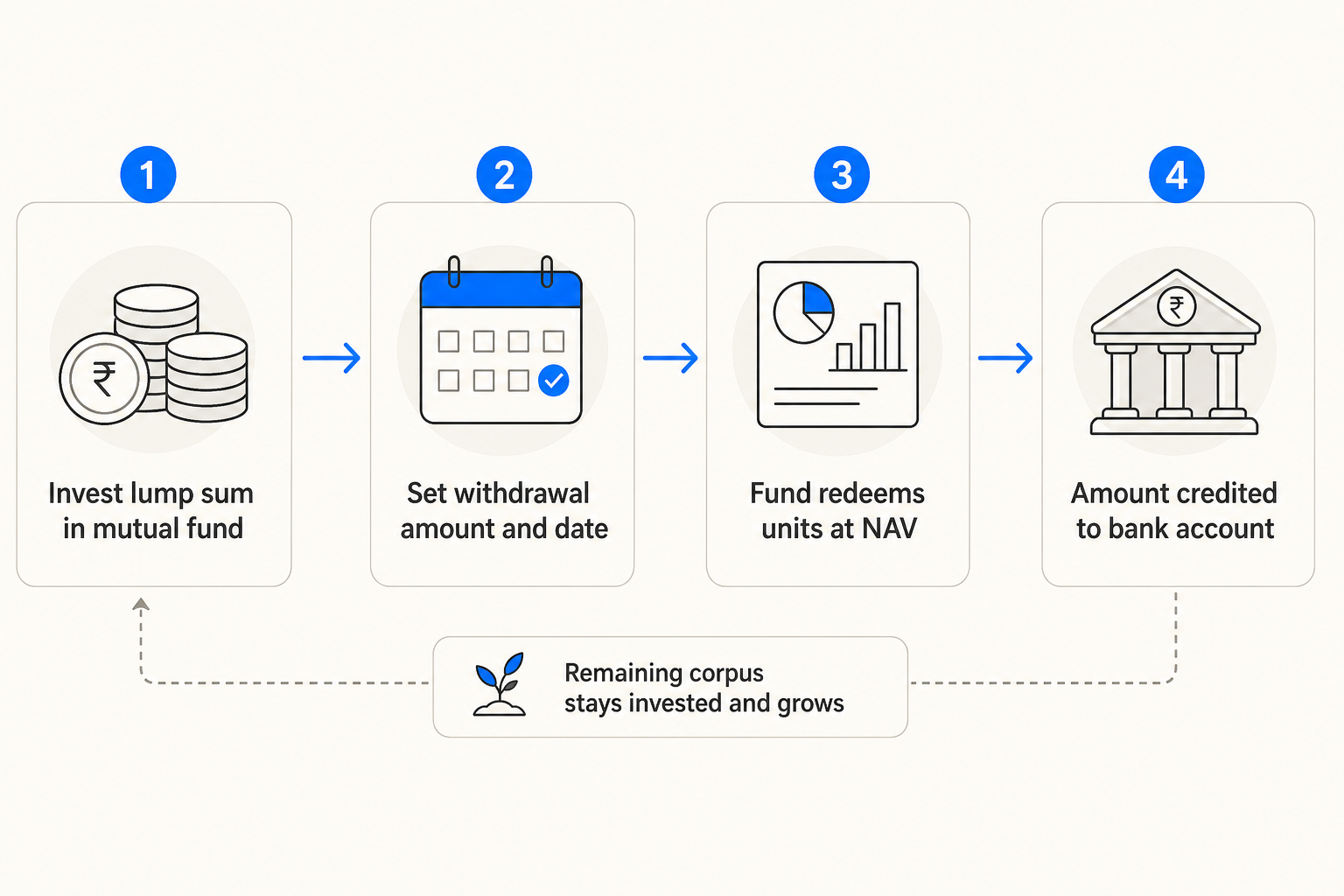
A Systematic Withdrawal Plan (SWP) lets you withdraw a fixed amount from your mutual fund investment at regular intervals – monthly, quarterly, or annually. The fund house calculates how many units to sell based on the current NAV, deposits the cash into your bank account, and leaves the rest invested.
It’s the mirror image of a SIP. Where a SIP puts money in every month, an SWP takes money out. The remaining corpus stays in the market and continues compounding.
The mechanical example from ET Money makes this concrete: if you want ₹10,000/month and the fund’s NAV is ₹50, the fund redeems 200 units (₹10,000 ÷ ₹50). Next month, if NAV has moved to ₹55, only 182 units are redeemed. This is “reverse rupee cost averaging” – fewer units go out when the market is up, more when it’s down, which moderates the impact of volatility over time.
SWP is most useful for:
- Retirees who need a monthly income stream without liquidating their entire portfolio at once
- Anyone who wants regular income alongside salary or business income
- Investors building a “pension substitute” from their mutual fund corpus
- People who don’t want to time their exit during market highs or lows
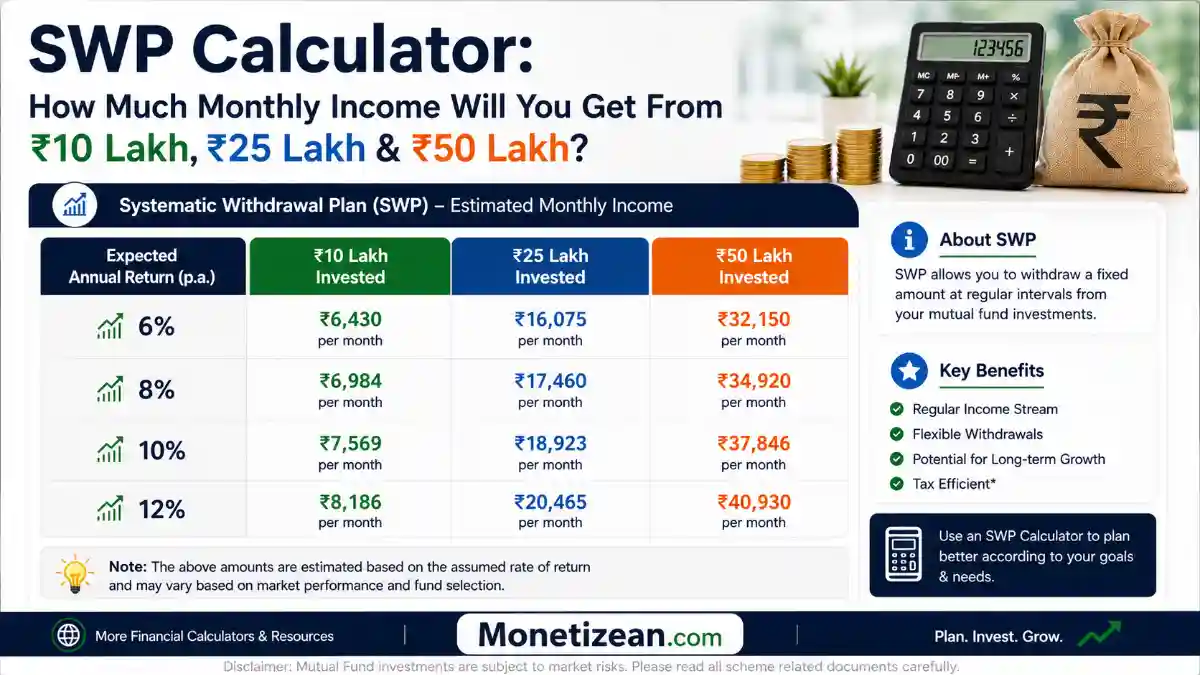
The math: how much can ₹1 crore generate per month?
This is the question everyone actually wants answered – and the answer is more nuanced than most sources let on.
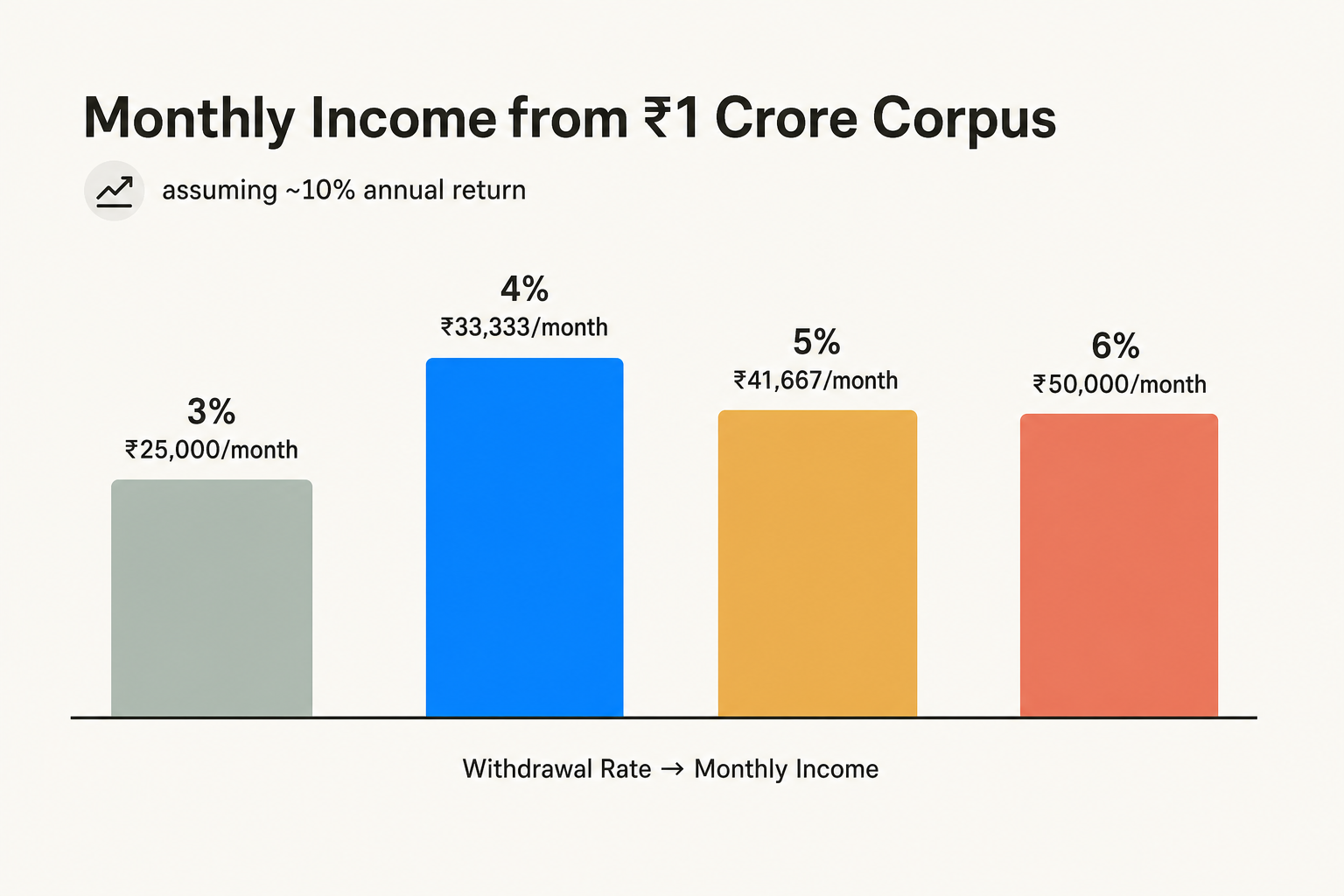
The HisabKaro SWP calculator runs a month-by-month corpus simulation, and their withdrawal rate table is the clearest way to frame the decision:
| Annual withdrawal rate | Monthly income from ₹1 crore | What happens to your corpus (at ~10% fund return) |
|---|---|---|
| 3% p.a. | ₹25,000/month | Grows significantly |
| 4% p.a. | ₹33,333/month | Safe – widely recommended |
| 5% p.a. | ₹41,667/month | Mild erosion over 20+ years |
| 6% p.a. | ₹50,000/month | Moderate erosion – plan carefully |
| 7%+ p.a. | ₹58,333+/month | Likely depletion within 15-20 years |
Source: HisabKaro SWP Calculator
The key principle: if your fund’s annual return is higher than your withdrawal rate, your corpus grows. If it’s lower, it shrinks. At 10% fund return and 4% withdrawal, the 6% difference compounds in your favour year after year.
The 4% figure originates from the Trinity Study, which found a 4% annual withdrawal rate kept a diversified portfolio intact over 30 years in US markets. The HisabKaro team notes that in the Indian context – where equity mutual funds have historically returned 10–12% annually and inflation runs at ~6% – a 3–4% withdrawal rate is considered conservative and sustainable, while 5–7% sits in the “plan carefully” range.
A thread in r/personalfinanceindia discussing a ₹9.5 crore SWP plan noted that their ₹3.25 lakh monthly withdrawal worked out to a 4.1% annual rate – described by the community as “within the safe range of 4-7%.” The Indian FIRE community tends to accept a slightly higher ceiling than the Western 4% rule, given higher expected equity returns.
The inflation problem nobody talks about enough
Here’s the thing most SWP articles gloss over: a fixed ₹50,000/month withdrawal in 2026 will feel like ₹28,000 in ten years at 6% inflation. In twenty years, it’s worth ₹15,600 in real terms.
This is where a step-up SWP makes a real difference. Instead of locking in a fixed amount forever, you increase your withdrawal by 5–7% annually – which roughly tracks inflation. Many mutual fund platforms support this; where they don’t, you give a revised SWP mandate each year. The corpus math still works because your fund’s growth rate (10–12%) should outpace the combined withdrawal + step-up rate, as long as you started with a sustainable base.
A concrete example from financial planner CA Piyush Kedia (quoted on AdvisorKhoj): with ₹50 lakh at 9% returns, you can start a ₹20,000/month SWP and increase it 5% each year. Over 35 years, total withdrawal reaches ₹2.16 crore – and there’s still ₹90 lakh left in the corpus.
SWP vs FD vs dividend plan
Most retirees are comparing SWP to fixed deposits or the older dividend option. Here’s how they actually stack up:
| Feature | SWP (equity fund) | Fixed Deposit | Dividend plan |
|---|---|---|---|
| Expected return | 9–12% p.a. (historical) | 6–7% p.a. | Varies, not guaranteed |
| Tax on income | 12.5% LTCG on gains only | Income slab rate (up to 30%) | Income slab rate (post 2020) |
| Regular income | Predictable (you set the amount) | Predictable | Unpredictable (AMC decides) |
| Capital protection | Corpus stays invested + grows | Principal protected | Corpus affected by payouts |
| Inflation hedge | Yes (equity exposure) | No | Limited |
The tax comparison is where SWP becomes compelling for anyone in the 20–30% tax bracket.
ET Money explains it clearly: SWP from an equity mutual fund has no TDS. The tax applies only to the capital gains portion of each withdrawal – not the full amount. For long-term units (held over 12 months), LTCG above ₹1.25 lakh per year is taxed at just 12.5%. The return-of-capital component is completely untaxed.
Worked example: you withdraw ₹6 lakh/year from a ₹1 crore equity MF corpus. If 80% is return of principal and 20% is gains, that’s ₹1.2 lakh in gains – under the ₹1.25 lakh threshold. Tax: ₹0. For the same ₹6 lakh from an FD at the 30% slab, you’d owe ₹1.8 lakh in tax. The difference is significant.
Debt mutual funds lost their tax advantage after the April 2023 rule change – gains are now taxed at your income slab rate regardless of holding period. This makes equity or hybrid funds relatively more attractive for SWP in most cases.
Best mutual fund categories for SWP
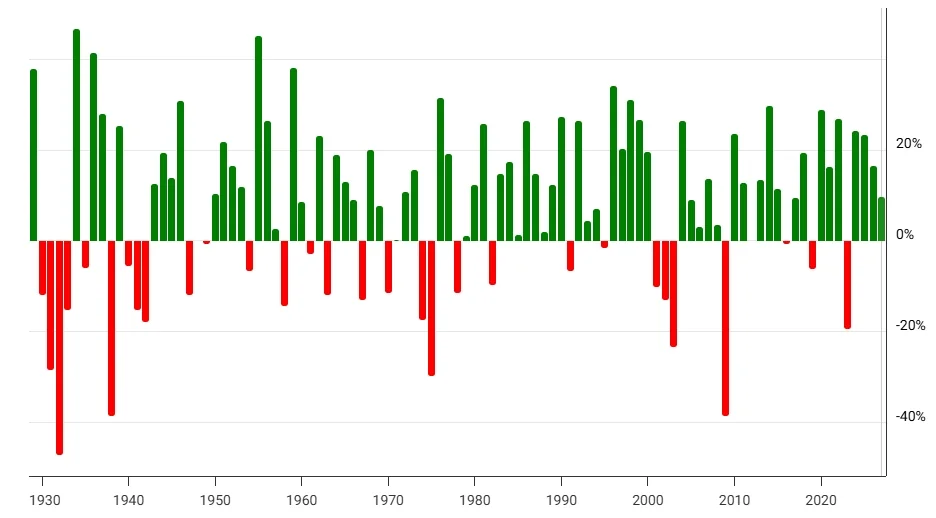
Fund selection probably matters more for SWP than for any other mutual fund use case. In a regular investment, you can ride out volatility. In SWP, a market crash forces you to redeem more units per withdrawal – eroding your corpus faster and making recovery harder. The technical term is “sequence of returns risk.”
1. Balanced advantage funds – the SWP default
Balanced advantage funds (also called dynamic asset allocation funds) shift equity and debt exposure based on market valuations – typically rising equity allocation when markets are cheap, and pulling back when valuations stretch. This dampening effect is exactly what SWP investors need.
ICICI Prudential Balanced Advantage Fund is the most-cited option across platforms – AUM of ₹72,486 crore, 1-year return of 5.13%, and a track record of actively managing equity/debt splits through volatile periods. At ₹72,486 crore, it’s one of India’s largest mutual funds, which also means deep liquidity.
HDFC Balanced Advantage Fund is the other consistent recommendation. Both funds have delivered 9–11% annualized returns over long periods, which makes the 4% withdrawal rate comfortably sustainable.
2. Aggressive hybrid funds – for those with a longer horizon
These hold 65–80% in equity with the rest in debt. More return potential, more volatility – better suited to investors aged 55–60 with at least a 15–20 year horizon.
The AdvisorKhoj backtesting data (13+ years of monthly SWP, ₹1 lakh lump sum) shows strong historical XIRR:
| Fund | XIRR (13+ years with monthly SWP) |
|---|---|
| SBI Equity Hybrid Fund | 22.36% |
| ICICI Pru Equity & Debt Fund | 21.40% |
| Tata Aggressive Hybrid Fund | 21.16% |
| HDFC Hybrid Equity Fund | 20.56% |
Source: AdvisorKhoj SWP research tool
These historical numbers are impressive, but remember: past performance doesn’t guarantee future results, and the 13-year window includes a very strong equity bull run.
3. Equity savings funds – for conservative investors
These funds hold a three-way mix: equity, debt, and arbitrage. Expected returns of 5–8%. Less growth than balanced advantage, but much lower volatility. Useful if you absolutely can’t stomach drawdowns, but the lower return ceiling means you need either a smaller withdrawal rate or a larger corpus.
HDFC Equity Savings Fund (AUM ₹5,640 crore, 1Y return 2.45%) is a common pick in this category.
Direct plans: the hidden lever
One thing the fund recommendations almost never mention loudly enough: use direct plans. The expense ratio difference between direct and regular plans ranges from 0.5% to 1% per year. On a ₹1 crore corpus, that’s ₹50,000–₹1 lakh annually leaving your corpus unnecessarily. Over 20 years of SWP, that difference compounds into a meaningful gap. Platforms like Groww, Kuvera, and Zerodha Coin all offer direct plans with no transaction cost.
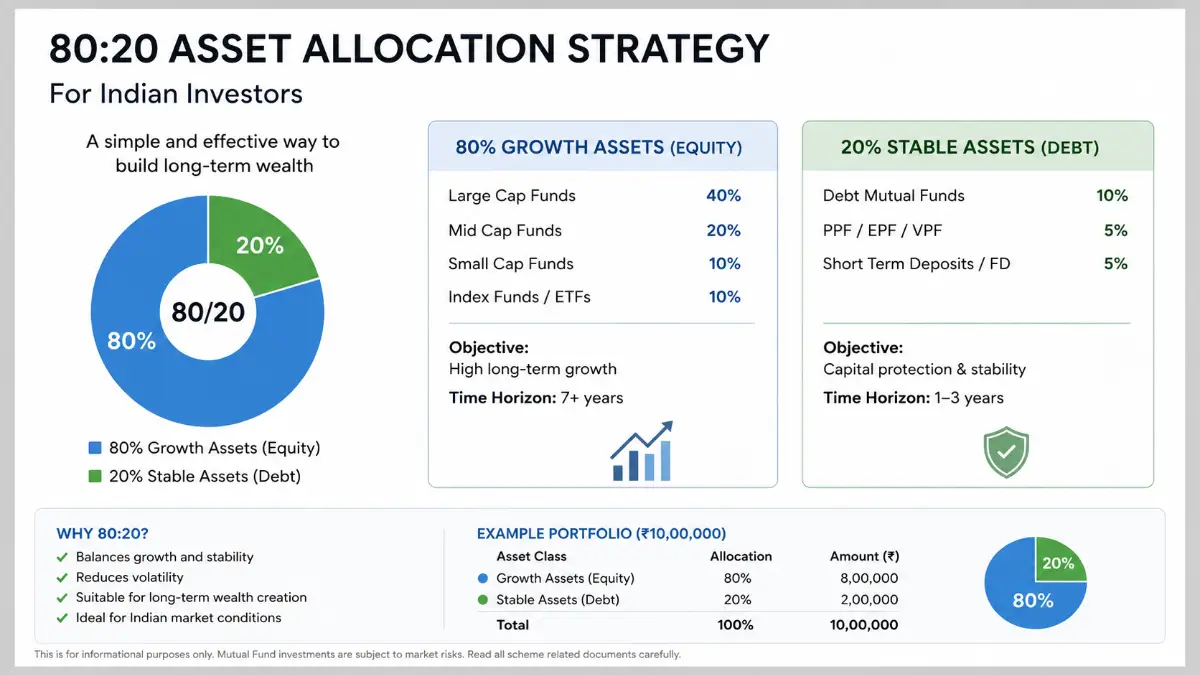
The two-bucket strategy
Pure SWP from a single equity fund has one vulnerability: a prolonged market downturn in your first few years of withdrawal can permanently impair your corpus. Sequence of returns risk is most damaging early.
The two-bucket approach addresses this:
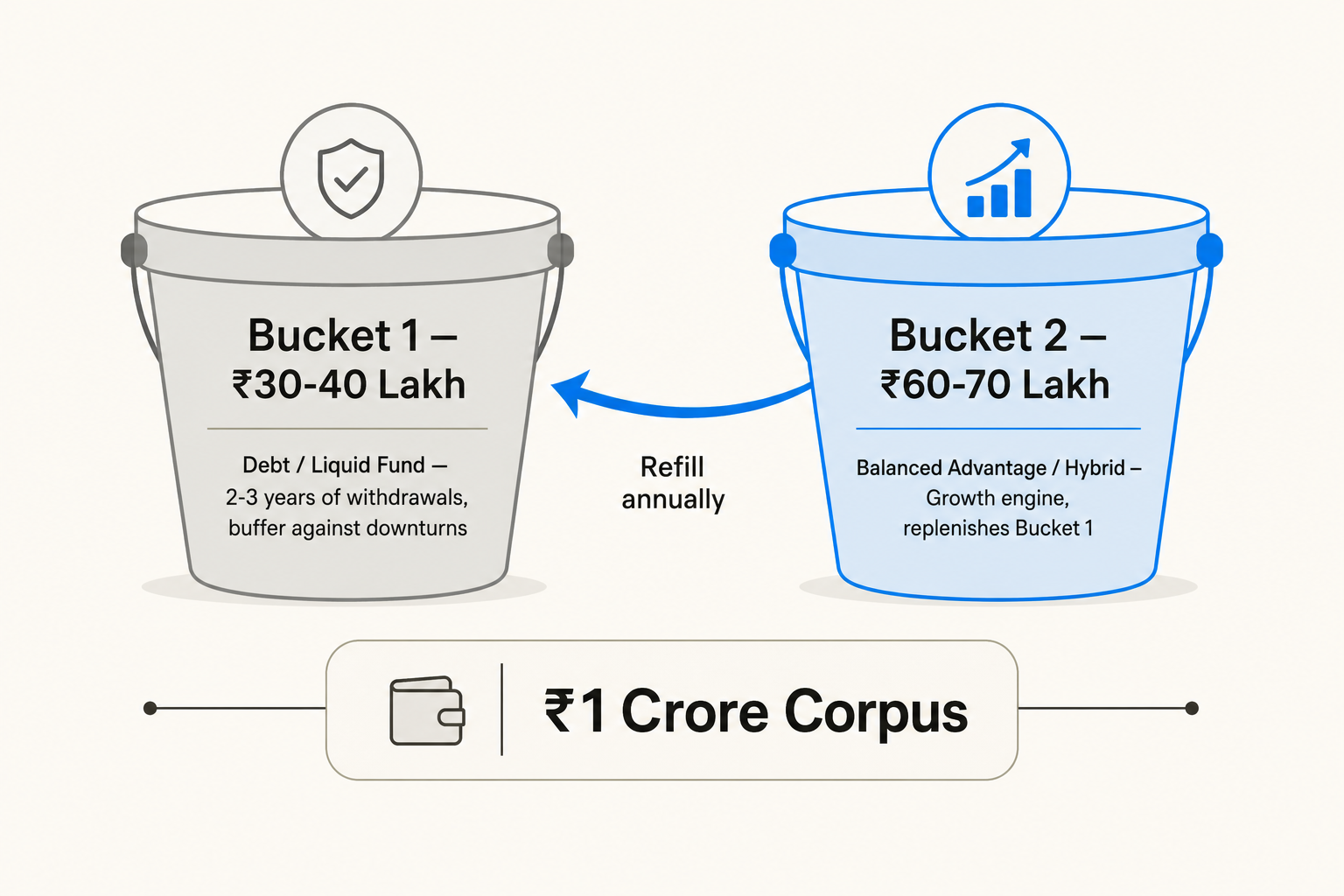
- Bucket 1 (₹30–40 lakh): Liquid or short-duration debt fund. Holds 2–3 years of monthly withdrawals. You draw SWP from here. This bucket never touches equity markets.
- Bucket 2 (₹60–70 lakh): Balanced advantage or aggressive hybrid fund. This is the growth engine. When markets are up, you transfer some appreciation into Bucket 1 to refill it.
The logic: if equity markets crash 30% in Year 2, you’re drawing from the debt bucket – so you’re not forced to sell equity at the worst time. Bucket 2 has time to recover. You only touch it when it has recovered.
This setup has a higher setup complexity than a single-fund SWP, but it dramatically improves corpus longevity, especially for someone who starts SWP at 60 and needs the plan to run for 25–30 years.
Tax efficiency: the real SWP advantage
Let’s make the tax math concrete, because this is often the deciding factor.
From ET Money’s SWP guide:
- No TDS on SWP withdrawals (unlike FD interest)
- Tax only on the capital gains portion of each redemption, not the full withdrawal
- For equity mutual funds (units held > 12 months): LTCG at 12.5% on gains above ₹1.25 lakh/year
- For equity mutual funds (units held < 12 months): STCG at 20%
- For debt funds: income slab rate regardless of holding period
The implication for a ₹50,000/month SWP from a long-held equity fund: assuming 70% of the redemption is return of capital (principal), only 30% – ₹15,000/month or ₹1.8 lakh/year – is capital gains. The first ₹1.25 lakh of that is exempt. So taxable LTCG is just ₹55,000, and at 12.5%, the tax bill is ₹6,875 for the year.
Compare that to an FD at 7% on ₹1 crore: ₹7 lakh in annual interest, fully taxable at your slab rate. At 30%, that’s ₹2.1 lakh in tax. For someone in that bracket, the SWP saves over ₹2 lakh in tax per year – which, invested back, compounds meaningfully over a 20-year retirement.
Common SWP mistakes (and how to avoid them)
Most of the grief in r/IndiaInvestments threads on SWP comes down to a few repeatable errors:
1. Starting with withdrawal amount, not withdrawal rate
“I need ₹60,000/month” is fine as a target. But the real question is: what does ₹60,000/month represent as a percentage of your corpus? ₹60,000/month from ₹1 crore is a 7.2% annual withdrawal rate – in territory where corpus depletion is likely within 15 years. The math has to work.
2. Using a volatile fund
Pure large-cap or mid-cap funds are great for wealth accumulation but poor for SWP. A 20% market drop in Year 1 of your SWP means you’re redeeming a lot more units per withdrawal just when prices are low. Balanced advantage funds are built to smooth this out.
3. Ignoring exit loads
Most equity funds charge a 1% exit load if units are redeemed within 1 year of purchase. For a lump sum invested to start a SWP, verify the exit load timeline before you begin withdrawals, or choose a fund that allows SWP to begin after the load period.
4. Not accounting for inflation
Setting ₹33,333/month and never revisiting it means your real purchasing power halves in about 12 years. A step-up SWP increasing by 5–7% annually is worth the administrative effort.
5. Choosing regular plans instead of direct
A 0.7% higher expense ratio on ₹1 crore is ₹7,000/month of unnecessary drag. At a 10% compounded return, this compounds to roughly ₹20–25 lakh over 20 years – a substantial cost for the same underlying fund.
How to set up an SWP in 5 steps
Build the corpus. You need ₹1 crore (or your target amount) in the mutual fund before starting SWP. This comes from a lump sum investment or from accumulated SIP units. If using SIP, wait until the corpus target is reached before activating SWP.
Choose your fund. For most investors: a balanced advantage fund. For those comfortable with more equity: an aggressive hybrid. Use a direct plan. Minimum lump sum on most platforms: ₹5,000–₹10,000 (but you’re investing ₹1 crore, so this isn’t a constraint).
Log into your platform and set up SWP. On Groww, Kuvera, Zerodha Coin, or Paytm Money: go to the fund’s page → choose SWP → set withdrawal amount, date (usually 1st–5th of month), and frequency. Minimum SWP on most platforms is ₹500–₹1,000/month.
Wait for units to clear the exit load period. Most equity funds have a 1% exit load for 12 months from purchase. Wait until your units are 12 months old before SWP begins, or choose a fund with no or minimal exit loads for SWP.
Review annually. Check whether your corpus is growing or shrinking. Adjust the withdrawal amount if needed. Step up by 5–7% if your corpus can support it. If you used the two-bucket strategy, refill Bucket 1 from Bucket 2 after market recoveries.
“For a senior citizen wanting to withdraw 6% annually via SWP – which category is best?”
- AdvisorKhoj forum reader, answered with community consensus: balanced advantage funds for their lower volatility, with an eye on maintaining a 3-4 year cash buffer.
Is ₹1 crore enough for retirement?
This depends entirely on your monthly expenses and whether you have other income sources.
At ₹33,333/month (4% withdrawal), you’re looking at a comfortable supplementary income – not a full replacement income in most urban metros. ₹33,333 covers groceries and utilities comfortably in a tier-2 city, but combined with a pension, rental income, or reduced post-retirement expenses, it works well.
If you need ₹50,000/month and want it to be sustainable, you’re looking at either a ₹1.5 crore corpus (at 4%) or accepting the gradual corpus erosion of a 6% withdrawal rate on ₹1 crore.
Per Kotak Life, ₹1 crore spending ₹40,000/month may last around 20 years with 6–7% returns – which is adequate if you retire at 65. For a 55-year-old, you need a plan that lasts 30 years, which pushes you firmly toward the 3–4% withdrawal range or a larger corpus.
The honest answer: ₹1 crore is a meaningful retirement corpus, but not an “all-in” solution for most people. It’s an excellent foundation – and an SWP at 4% makes that foundation genuinely durable.
Frequently Asked Questions
How much can I withdraw monthly from a ₹1 crore SWP?
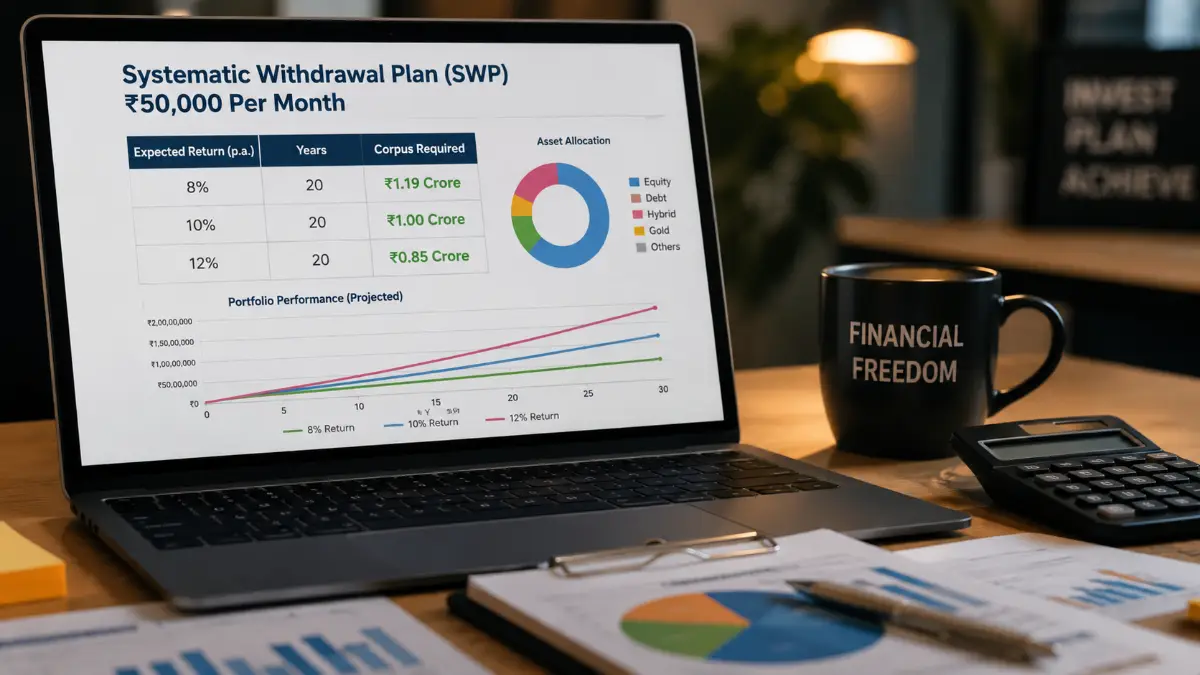
At a 4% annual withdrawal rate – widely considered safe – you can withdraw ₹33,333 per month from a ₹1 crore corpus. At 6% you get ₹50,000/month, but your corpus will erode slowly over 20+ years. The exact amount depends on your fund’s actual returns; a SWP calculator can model your specific scenario.
Is SWP better than a fixed deposit for retirement income?
For most retirees in the 20-30% tax bracket, yes. FD interest is fully taxable at your income slab rate. SWP from an equity mutual fund taxes only the capital gains portion – and at 12.5% LTCG (after the ₹1.25 lakh exemption), not your slab rate. The net post-tax return is usually higher with SWP.
What is the safest fund category for SWP?
Balanced advantage funds (also called dynamic asset allocation funds) are considered the safest category for SWP. They dynamically adjust equity and debt allocation based on market valuations, which limits corpus erosion during market downturns. Top picks include ICICI Prudential Balanced Advantage Fund and HDFC Balanced Advantage Fund.
How long will ₹1 crore last with SWP?
At 4% annual withdrawal rate (₹33,333/month) and a 10% fund return, your ₹1 crore corpus should grow over time – theoretically lasting indefinitely. At a 6% withdrawal rate (₹50,000/month), it may last 20-25 years. At 8-9% withdrawal rate, expect depletion within 12-15 years. Per Kotak Life, ₹1 crore at ₹40,000/month may last around 20 years with 6-7% returns.
Is TDS deducted on SWP withdrawals?
No. Unlike bank FDs, there is no TDS on SWP withdrawals from mutual funds. However, you are responsible for self-reporting and paying capital gains tax on the gains portion at the applicable rate: 12.5% LTCG for equity funds (units held over 1 year) on gains above ₹1.25 lakh, or 20% STCG for units held under 1 year. See the ET Money guide for details.






Clear and useful tips here. One AI music tool I use is Happy Shrimp: /. Happy Shrimp
Great post. Also recommend for AI workflows. hailuo 3
Gracias por compartir. Worth trying . ai video continuer
Very helpful article. Also recommend for AI workflows. seedream 5 pro
Great post. Useful: . flux 3
Very helpful article. Useful: . seeddance2.5
Great post. Also recommend for AI workflows. wan 3.0
Thanks for sharing this. Also recommend for AI workflows. Seedance 2.5
Thanks for sharing this. Useful: . minimax music
Gracias por compartir. Also recommend for AI workflows. flux 3
Gracias por compartir. Worth trying . happyshrimp ai
Very helpful article. Worth trying . Watermarks Remover
Praktisch. Schau dir Gem Transcribe an: . Gem Transcribe
Solid explanation. I stumbled on fasth3 recently and it helped me get unstuck on a project like this.
Thanks for sharing this. I had good results with gpt transcribe when I was trying something along the same lines.
Well written. I have been experimenting with minimax h3 max on and off, and your post connected a few dots I had missed.
Thanks for sharing this. I had good results with HTML to URL when I was trying something along the same lines.
Nice article. I came across krea 2 while looking into similar tools and thought it fit well with what you described.
Useful perspective. A friend mentioned banan paper last week, and after reading your article I finally understood why.
Solid explanation. I stumbled on fast h3 recently and it helped me get unstuck on a project like this.
Useful perspective. A friend mentioned gpt transcribe last week, and after reading your article I finally understood why.
Great breakdown. I ended up testing h3 max after reading posts like this, and it saved me a bit of trial and error.
Well written. I have been experimenting with html to url converter on and off, and your post connected a few dots I had missed.
Solid explanation. I stumbled on krea 2 recently and it helped me get unstuck on a project like this.
Solid explanation. I stumbled on paper banan recently and it helped me get unstuck on a project like this.
Appreciate the detail here. afflune has been a useful reference when I was figuring out the same thing.
Useful perspective. A friend mentioned seedance api online last week, and after reading your article I finally understood why.
Nice article. I came across edit text in image with the same font while looking into similar tools and thought it fit well with what you described.
I was stuck on a similar problem last month. remove people from picture was not the only option, but it was the one that actually stuck for me.
Well written. I have been experimenting with seedance 2.5 on and off, and your post connected a few dots I had missed.