1. Introduction
A ₹3,000, ₹5,000, and ₹10,000 monthly SIP starting today can grow into ₹30 lakh, ₹50 lakh, and nearly ₹1 crore respectively by 2046, purely from compounding at a 12% CAGR.
The gap between the smallest and largest SIP isn’t just proportional — it widens sharply because each rupee invested earlier compounds for longer.
This guide uses real AMFI 2026 data and standard SIP compounding math to show exactly what each contribution level builds by 2046, with 2027-2032 growth context.
2. Market Overview
India’s mutual fund industry AUM touched ₹85.75 lakh crore in July 2026, with monthly SIP collections of ₹31,960.66 crore from over 10.62 crore contributing accounts.
SIP assets alone crossed ₹17.12 lakh crore by May 2026, forming close to 21% of total industry AUM — proof that systematic investing has become India’s dominant retail wealth-building channel.
Equity funds have posted 53 consecutive months of positive net inflows through May 2026, even amid global volatility from crude oil price spikes and FPI selling.
| Metric | Value (2026) |
|---|---|
| Total MF Industry AUM | ₹85.75 lakh crore (Jul 2026) |
| Monthly SIP Inflow | ₹31,960 crore (Jul 2026) |
| SIP AUM | ₹17.12 lakh crore (May 2026) |
| Contributing SIP Accounts | 10.62 crore |
| SIP AUM Growth (YoY) | +15.32% |
3. Key Data Insights: SIP Corpus at 20 Years
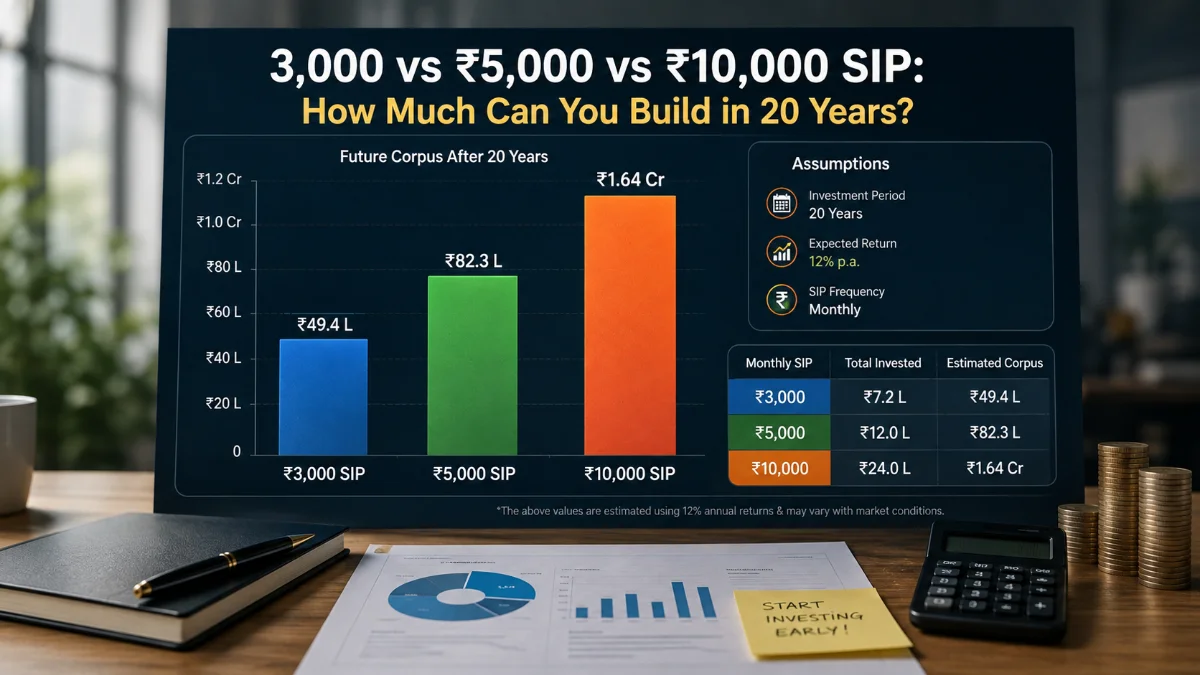
Using the standard SIP future-value formula across three CAGR scenarios, here’s what ₹3,000, ₹5,000, and ₹10,000 monthly SIPs build over 240 months (20 years):
| Monthly SIP | Total Invested | Corpus @12% CAGR | Corpus @14% CAGR | Corpus @16% CAGR |
|---|---|---|---|---|
| ₹3,000 | ₹7.2 lakh | ₹29.97 lakh | ₹39.50 lakh | ₹52.48 lakh |
| ₹5,000 | ₹12 lakh | ₹49.96 lakh | ₹65.83 lakh | ₹87.47 lakh |
| ₹10,000 | ₹24 lakh | ₹99.91 lakh | ₹1.32 crore | ₹1.75 crore |
At 12% CAGR, wealth gained purely from compounding is 4.2x the invested amount for every SIP size — proof that duration matters more than the monthly figure alone.
CAGR Estimates by Fund Category (Illustrative, 2027-2032)
| Fund Category | Historical Long-Term CAGR | 2027-2032 Estimate Range |
|---|---|---|
| Large-Cap Funds | 11-13% | 10-12% |
| Flexi-Cap Funds | 13-15% | 11-14% |
| Mid-Cap Funds | 15-18% | 12-16% |
| Small-Cap Funds | 16-20% | 12-17% |
These are illustrative estimate ranges based on historical category performance, not guaranteed forecasts — actual returns will vary with market cycles.
4. Investment Strategy
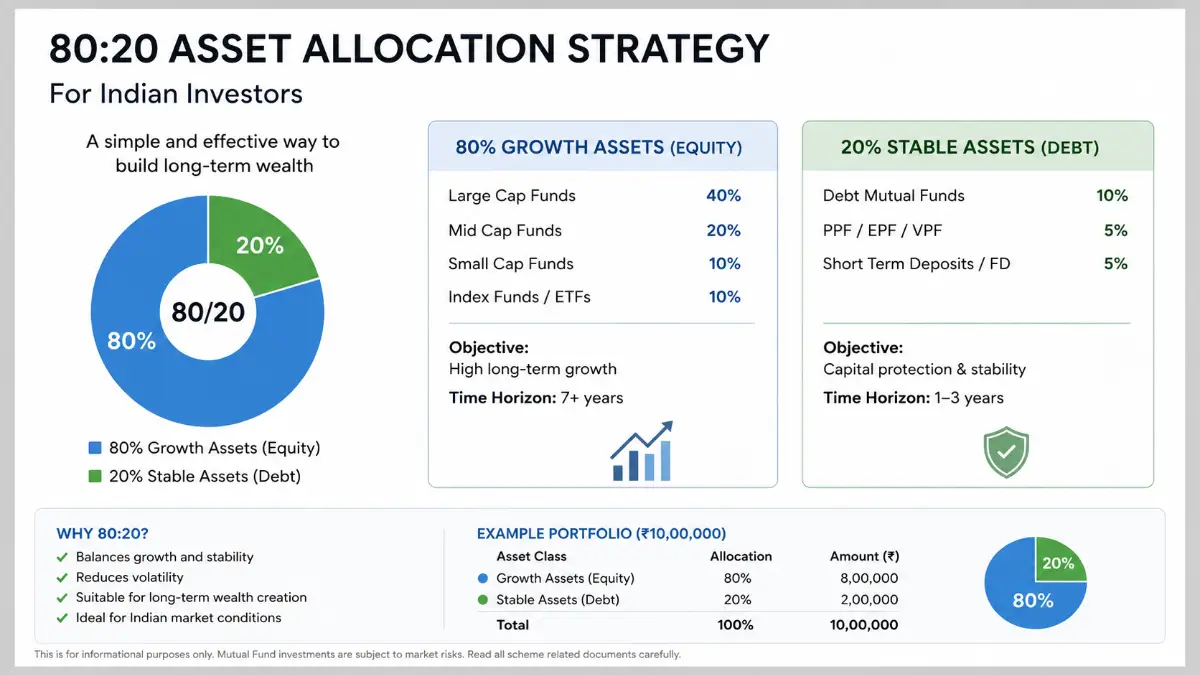
A ₹3,000 SIP suits investors starting out; a ₹10,000 SIP suits those with stable income wanting a faster crore-plus target. The strategy that matters most is allocation, not amount.
Category-wise, flexi-cap funds led equity inflows through March-April 2026 at over ₹10,000 crore monthly, while small-cap and mid-cap funds have drawn the strongest retail preference through mid-2026.
| SIP Size | Suggested Large-Cap | Suggested Flexi-Cap | Suggested Mid/Small-Cap |
|---|---|---|---|
| ₹3,000 | 50% | 30% | 20% |
| ₹5,000 | 40% | 35% | 25% |
| ₹10,000 | 35% | 35% | 30% |
A 10% annual step-up on a ₹5,000 SIP pushes the effective 20-year contribution far above a flat ₹10,000 SIP’s total invested amount, while still starting with a lower initial outflow — a practical middle path for rising incomes.
5. Growth Forecast (2027-2032)
Assuming SIP inflows continue their 15.32% year-on-year AUM growth pace recorded in 2026, industry-wide SIP AUM could realistically approach ₹30-32 lakh crore by 2030 if growth moderates to 10-12% annually post-2027.
| Year | Est. Industry SIP AUM (₹ lakh crore) | Est. Monthly SIP Inflow (₹ crore) |
|---|---|---|
| 2026 | 17.1 | ~32,000 |
| 2027 | 19.5 | ~35,000 |
| 2028 | 22.0 | ~38,500 |
| 2030 | 27.5 | ~46,000 |
| 2032 | 34.0 | ~55,000 |
Forecast figures are directional estimates extrapolated from the current 15.32% YoY SIP AUM growth trend, not official AMFI projections.
6. Risk Analysis
Larger SIPs don’t automatically carry more risk — fund category concentration does. May 2026 alone saw net equity inflows fall 40.4% month-on-month amid crude oil price shocks and geopolitical tension, showing even disciplined SIPs face short-term volatility.
| Fund Category | Volatility Level | Typical Drawdown Risk | Best Suited SIP Horizon |
|---|---|---|---|
| Large-Cap | Low-Moderate | 15-20% | 10+ years |
| Flexi-Cap | Moderate | 20-25% | 10+ years |
| Mid-Cap | High | 25-35% | 15+ years |
| Small-Cap | Very High | 35-45% | 20+ years |
The SIP stoppage ratio rose through early 2026 even as inflow value stayed strong — a reminder that market dips test discipline more than they test the math.
7. Conclusion
Over 20 years, the difference between ₹3,000, ₹5,000, and ₹10,000 SIPs isn’t just the multiple of contribution — compounding turns a 3.3x monthly gap into a corpus gap of nearly ₹70 lakh at 12% CAGR.
Whichever amount you start with, consistency through market cycles and a 10% annual step-up matter more than perfectly timing the “ideal” SIP size.
Frequently Asked Questions
Which SIP amount is best for beginners — ₹3,000 or ₹5,000?
₹3,000 works well for first-time investors with limited surplus. Stepping up to ₹5,000 via a 10-15% annual increase builds a meaningfully larger corpus without straining monthly cash flow.
Can a ₹10,000 SIP realistically cross ₹1 crore in 20 years?
Yes — at 12% CAGR it reaches approximately ₹99.9 lakh, and at 14% CAGR it crosses ₹1.3 crore over 240 months.
Is 12% or 15% a realistic long-term SIP return assumption for 2026 onward?
Most SEBI-registered advisors treat 10-12% as a conservative long-term equity assumption and 13-15% as an optimistic one.
Does a bigger SIP mean bigger risk?
No — risk comes from fund category concentration, not contribution size. A ₹10,000 large-cap SIP can be less volatile than a ₹3,000 small-cap SIP.
What is a step-up SIP and how does it change the outcome?
It raises your monthly contribution by a fixed percentage each year, typically 10%, letting a smaller starting SIP outgrow a flat larger one over two decades.
SEBI Disclaimer: Mutual fund investments are subject to market risks. Read all scheme-related documents carefully. Past performance is not indicative of future returns. Figures in this article are illustrative projections based on standard compounding formulas and publicly available AMFI data as of 2026; they are not investment advice or guaranteed returns. Consult a SEBI-registered investment advisor before making investment decisions.