
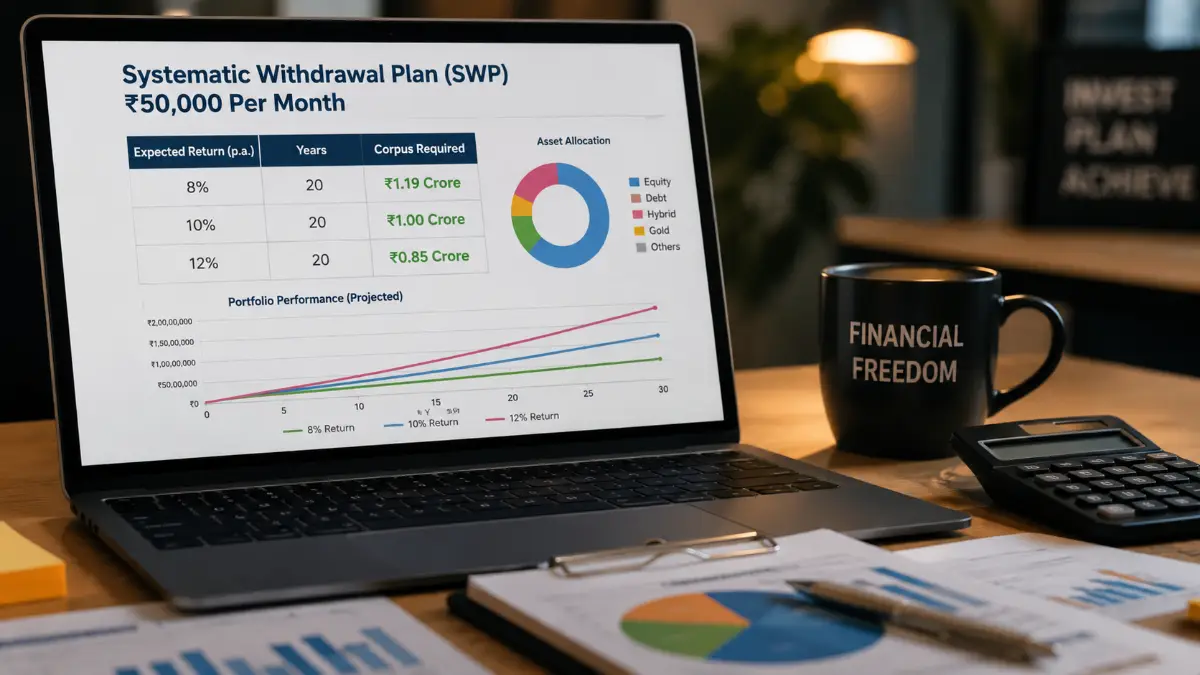
1. Introduction
An SWP (Systematic Withdrawal Plan) of ₹50,000 per month is one of the most searched retirement-income queries among Indian investors in 2026.
That works out to ₹6,00,000 per year in withdrawals — a figure that must be checked against your fund’s real, post-tax return.
This guide uses data-driven tables to show the corpus, CAGR, and risk assumptions behind a ₹50,000 monthly SWP, with projections through 2032.
2. Market Overview
India’s mutual fund AUM crossed ₹75 lakh crore in early 2026, per AMFI data, with SWP and STP accounts forming a fast-growing sub-segment.
Retail SIP and SWP combined accounts are estimated to grow at a 13-15% CAGR through 2030 as retirement-income planning gains traction among 35-55 year-olds.
| Year | Estimated Industry AUM (₹ lakh crore) | SWP/Retirement Segment Share |
|---|---|---|
| 2026 | 75-78 | ~6% |
| 2028 | 95-100 (projected) | ~8% (projected) |
| 2030 | 115-125 (projected) | ~10% (projected) |
| 2032 | 140-155 (projected) | ~12% (projected) |
Figures for 2028-2032 are illustrative industry projections, not guarantees.
3. Key Data Insights: Corpus Required for ₹50,000/Month
The corpus you need depends entirely on your assumed sustainable withdrawal rate — the % of corpus withdrawn annually.
| Withdrawal Rate | Annual Withdrawal | Corpus Required |
|---|---|---|
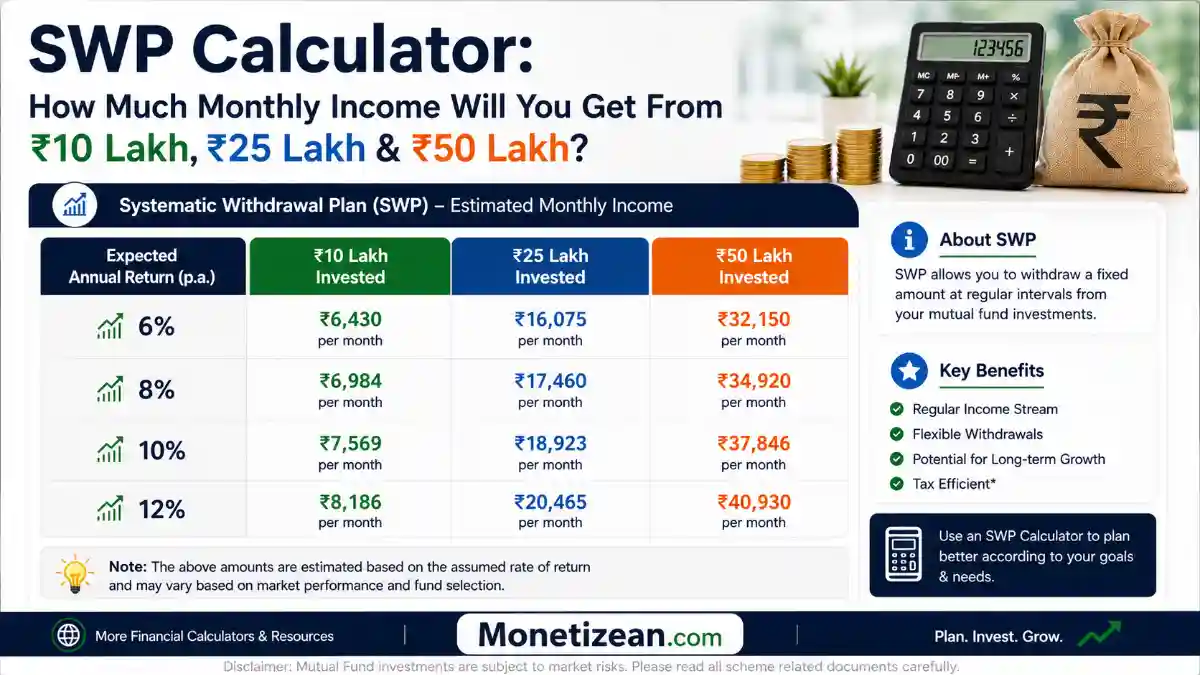
| 6% | ₹6,00,000 | ₹1,00,00,000 |
| 7% | ₹6,00,000 | ₹85,71,000 |
| 8% | ₹6,00,000 | ₹75,00,000 |
| 9% | ₹6,00,000 | ₹66,67,000 |
| 10% | ₹6,00,000 | ₹60,00,000 |
A 6-7% withdrawal rate is generally considered safer for capital preservation over 20+ years, per standard retirement-planning models.
4. Investment Strategy
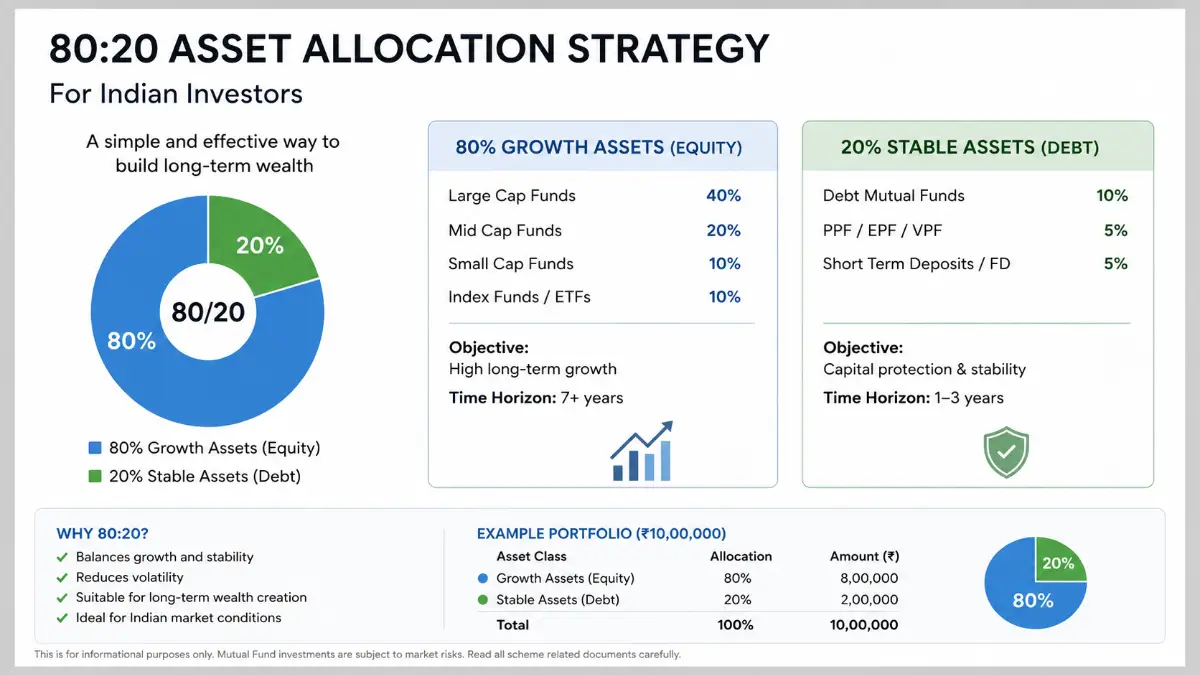
Most planners split SWP corpus across equity, debt, and gold to balance growth against monthly cash-flow stability.
| Risk Profile | Equity | Debt | Gold |
|---|---|---|---|
| Conservative | 25% | 65% | 10% |
| Balanced | 45% | 45% | 10% |
| Aggressive | 65% | 25% | 10% |
Practical tip: Route the first 2-3 years of withdrawals from debt/hybrid funds to avoid selling equity during a downturn — this reduces sequence-of-returns risk significantly.
Rebalancing annually keeps the allocation aligned as equity markets outperform debt in growth years.
5. Growth Forecast (2026-2032)
Illustrative CAGR ranges by asset class, based on historical 10-year averages and current market conditions:
| Asset Class | Estimated CAGR 2026-2032 |
|---|---|
| Large-cap Equity Funds | 11-13% |
| Hybrid/Balanced Funds | 8-10% |
| Debt Funds | 6.5-7.5% |
| Gold | 7-9% |
At a 10% CAGR, a ₹75 lakh corpus withdrawing ₹6 lakh/year (8% rate) could still show modest real growth after inflation of ~5-5.5%.
| Year | Opening Corpus (₹75L, 10% CAGR) | Withdrawal | Closing Corpus |
|---|---|---|---|
| 2026 | 75,00,000 | 6,00,000 | 76,50,000 |
| 2028 | ~82,00,000 | 6,00,000 | ~83,80,000 |
| 2030 | ~90,50,000 | 6,00,000 | ~92,95,000 |
| 2032 | ~1,00,00,000 | 6,00,000 | ~1,03,40,000 |
Table 5 assumes constant 10% returns for simplicity; real markets are volatile year-to-year.
6. Risk Analysis
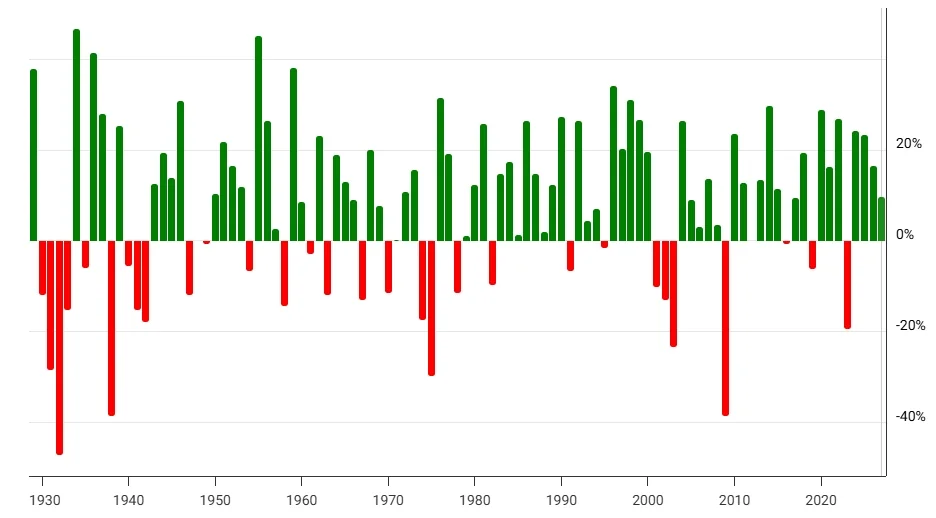
SWP performance depends heavily on sequence of returns — poor returns in the first 2-3 years hurt far more than poor returns later.
| Scenario | Risk Level | Reward Potential | Suitable For |
|---|---|---|---|
| Pure Equity SWP | High | 11-13% CAGR | 10+ year horizon, high risk appetite |
| Hybrid SWP | Moderate | 8-10% CAGR | Most retirees, 15-20 year horizon |
| Debt-only SWP | Low | 6.5-7.5% CAGR | Capital preservation priority |
A 2026-27 market correction of 10-15%, if it occurs early in an SWP, could reduce corpus longevity by 3-5 years compared to average-return scenarios.
Diversification across debt and equity, plus a conservative 6-7% withdrawal rate, is the most cited risk mitigant among certified financial planners.
7. Conclusion
A ₹50,000-per-month SWP typically needs a corpus between ₹60 lakh and ₹1 crore, depending on your withdrawal rate and fund mix.
Choosing a 6-7% withdrawal rate with a hybrid allocation offers the best balance of income and capital longevity through 2032.
Review your SWP allocation annually and adjust for actual market performance rather than fixed assumptions.
SEBI Disclaimer: Mutual fund investments are subject to market risks. Read all scheme-related documents carefully before investing. Past performance is not indicative of future returns. Figures in this article are illustrative projections for educational purposes only and do not constitute investment advice.
FAQs
Q1. How much corpus is needed for SWP of ₹50,000 per month?
At an 8% withdrawal rate, roughly ₹75 lakh; at 6%, roughly ₹1 crore.
Q2. Is SWP better than FD for monthly income?
SWP can be more tax-efficient since only the gains portion is taxed per withdrawal, but it carries market risk unlike FDs.
Q3. What is a safe withdrawal rate for SWP in India?
Most planners recommend 6-8% annually for hybrid/equity SWPs to preserve capital over 15-20 years.
Q4. Can SWP corpus run out before I need it?
Yes, especially if withdrawal rate exceeds actual returns during early market downturns.
Q5. Which fund category is best for SWP of ₹50,000 per month?
Balanced or conservative hybrid funds are most commonly used for their blend of stability and growth.






Appreciate the depth in this piece. For The Choicer Voicer and voice challenges, see The Choicer Voicer at . The Choicer Voicer
Clear and useful tips here. One Swift-image studio I use is Swift-image: /. Swift-image
Clair et pratique. Essayez MiniMax H3 Video Generator : /. MiniMax H3 Video Generator
Well explained and practical. I’ve had good results with H3MaxAI () for image-to-video shots. H3MaxAI
Ótimo post! Para transcrever voz online, confira MAI Transcribe 2: . MAI Transcribe 2