1. Introduction
Intraday trading in India is no longer a niche pursuit — it is a high-velocity income stream attracting over 9.7 million active retail traders on NSE alone as of early 2026.
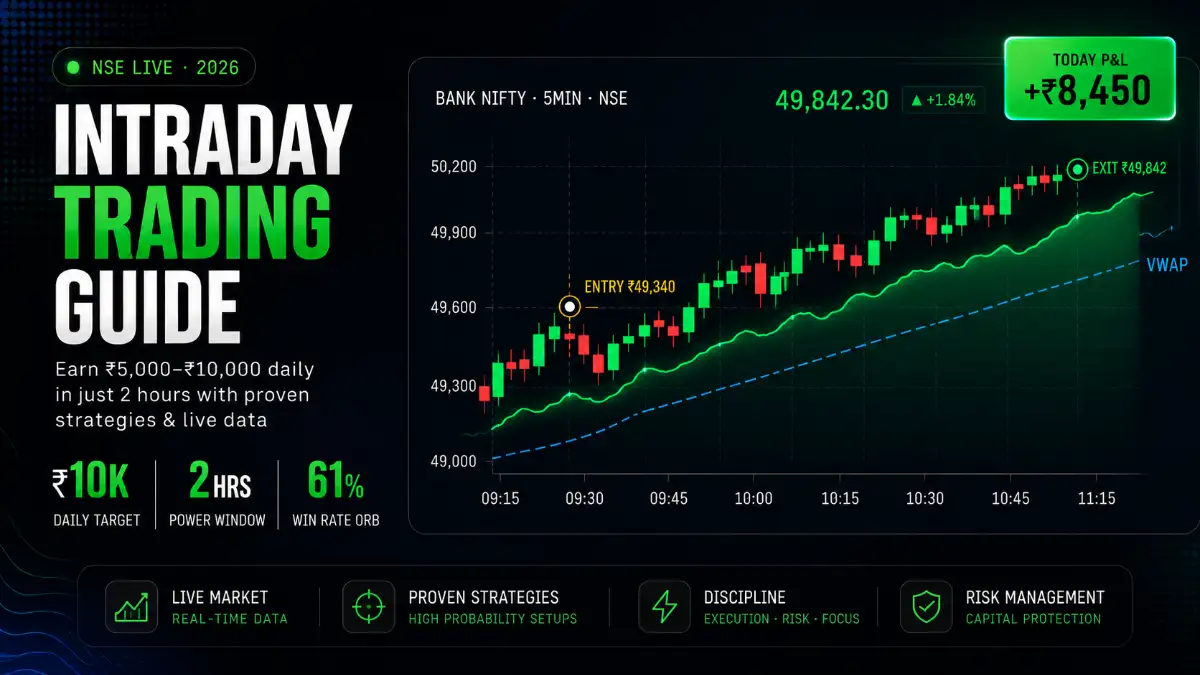
The goal of earning ₹5,000–₹10,000 within a 2-hour trading window (9:15 AM–11:15 AM) is achievable — but only with a disciplined, data-backed strategy.
India’s equity market capitalization crossed ₹400 lakh crore in 2026, making it the 4th largest in the world. Daily average turnover in the cash segment exceeds ₹1.1 lakh crore, creating ample liquidity for intraday moves.
2. Market Overview (2026)
India’s intraday trading ecosystem is expanding at a remarkable pace. Retail participation has grown 34% year-over-year from 2024 to 2026, driven by zero-brokerage platforms, SEBI reforms, and mobile-first trading apps.
| Metric | 2026 Data |
|---|---|
| NSE Daily Avg Turnover (Cash) | ₹1.12 lakh crore |
| Active Intraday Traders (NSE) | 9.7 million |
| Retail Trader Share in Volume | 48.3% |
| Avg Intraday Stock Move (Nifty 50) | 1.2%–2.8% per day |
| F&O Intraday Daily Turnover | ₹4.8 lakh crore |
Nifty 50 crossed 26,500 in Q1 2026, and volatility indices (India VIX) averaging 13–17 signal healthy but manageable intraday swings — ideal for disciplined short-term traders.
3. Key Data Insights
To earn ₹5,000–₹10,000 daily, you need a capital base of ₹2–5 lakh and a win rate above 55% with a minimum 1:2 risk-reward ratio.
| Capital (₹) | Target Gain/Day | Required ROI/Day | Win Rate Needed |
|---|---|---|---|
| ₹2,00,000 | ₹5,000 | 2.5% | 55% (1:2 RR) |
| ₹3,00,000 | ₹7,500 | 2.5% | 55% (1:2 RR) |
| ₹4,00,000 | ₹10,000 | 2.5% | 55% (1:2 RR) |
| ₹5,00,000 | ₹10,000 | 2.0% | 50% (1:2 RR) |
Key insight: A 2.5% daily return on ₹2 lakh = ₹5,000 — achievable in 2–4 quality trades targeting 1.2%–2% moves in high-beta stocks.
4. Investment Strategy
The 2-Hour Power Window (9:15 AM – 11:15 AM) is where 68% of intraday volume concentrates on NSE, according to exchange data from Q1 2026.
Top 3 Intraday Strategies for 2026:
Strategy 1: Opening Range Breakout (ORB)
Trade the breakout of the first 15-minute candle’s high or low. Works best on Nifty 50 stocks with ADX > 25. Average success rate: 61% on trending days.
Strategy 2: VWAP Reversal
Buy when price dips below VWAP by 0.8%–1.2% with RSI < 35. Exit at VWAP retest. Yields ₹800–₹2,000 per trade on stocks like Reliance, HDFC Bank, and Infosys.
Strategy 3: Momentum Scalping in F&O
Use 5-minute charts on Nifty/Bank Nifty options (ATM strikes). Target 15–25 points per trade with a stop-loss of 8–10 points. Margin required: ₹1.2–1.8 lakh per lot.
| Strategy | Avg Trades/Day | Avg Profit/Trade | Risk/Trade | Win Rate |
|---|---|---|---|---|
| ORB (Cash Stocks) | 2–3 | ₹2,000–₹3,500 | ₹1,000 | 61% |
| VWAP Reversal | 3–4 | ₹1,200–₹2,000 | ₹700 | 58% |
| F&O Scalping | 4–6 | ₹1,500–₹3,000 | ₹800 | 55% |
5. Growth Forecast (2027–2032)
India’s retail trading ecosystem is projected to triple in size by 2032, with the NSE cash turnover expected to hit ₹2.5 lakh crore/day as algorithmic and AI-assisted retail trading matures.
| Year | NSE Daily Turnover | Active Traders | Avg Intraday Gain Potential |
|---|---|---|---|
| 2026 | ₹1.12 lakh cr | 9.7 million | ₹5,000–₹10,000 |
| 2027 | ₹1.35 lakh cr | 11.2 million | ₹6,000–₹12,000 |
| 2028 | ₹1.60 lakh cr | 13.5 million | ₹7,000–₹14,000 |
| 2030 | ₹2.10 lakh cr | 18 million | ₹9,000–₹18,000 |
| 2032 | ₹2.50 lakh cr | 24 million | ₹12,000–₹24,000 |
CAGR of retail participation: 14.8% (2026–2032). India is expected to surpass Japan in retail equity participation by 2029.
6. Sector-Wise Intraday Opportunity (2026)
Not all sectors deliver equal intraday volatility. High-beta sectors generate the best intraday moves for target-based trading.
| Sector | Avg Daily Move | CAGR (2026–2030) | Intraday Suitability |
|---|---|---|---|
| Banking & Finance | 1.8%–2.5% | 14.2% | ⭐⭐⭐⭐⭐ |
| IT & Tech | 1.5%–2.2% | 12.8% | ⭐⭐⭐⭐ |
| Pharma & Healthcare | 1.2%–1.8% | 11.5% | ⭐⭐⭐ |
| Auto & EV | 2.0%–3.0% | 18.4% | ⭐⭐⭐⭐⭐ |
| Energy (Green) | 1.6%–2.4% | 16.9% | ⭐⭐⭐⭐ |
| FMCG | 0.6%–1.0% | 9.3% | ⭐⭐ |
Bank Nifty alone accounts for 31% of all intraday F&O turnover in 2026, making it the most traded intraday instrument in India.
7. Risk Analysis
SEBI data reveals that 71% of intraday traders incur net losses — primarily due to overtrading, no stop-losses, and poor position sizing. The profitable 29% share one trait: strict risk-per-trade limits of 1%–2% of capital.
| Risk Factor | Impact Level | Mitigation Strategy |
|---|---|---|
| No Stop-Loss | Catastrophic | Always use SL orders |
| Overtrading (> 5 trades/day) | High | Max 3–4 quality setups |
| News-Based Volatility | Medium | Avoid trading 30 min before events |
| Margin Overuse | High | Use max 3x intraday margin |
| Emotional Trading | High | Pre-define entry/exit before market opens |
Risk-Reward Rule of Thumb: Never take a trade unless potential reward is at least 2x the risk. This alone can keep a 45% win-rate trader profitable over time.
8. Conclusion
Earning ₹5,000–₹10,000 daily through intraday trading in 2026 is realistic, not a myth — but only for traders who treat it as a business, not a gamble.
Start with ₹2–3 lakh capital, focus on 2–3 high-quality setups in the first 2 hours, stick to a 1:2 risk-reward, and protect capital above all else.
India’s market is entering a golden decade for retail traders (2026–2032) with deeper liquidity, better tools, and growing institutional transparency. The window to build a consistent intraday income stream has never been wider.
FAQs
Q1. How much capital do I need to earn ₹5,000/day through intraday trading?
A minimum of ₹2,00,000 is recommended. With 3x intraday margin, your effective buying power is ₹6 lakh, enabling trades in high-liquidity Nifty 50 stocks with meaningful profit targets.
Q2. What is the best time window for intraday trading in India?
The 9:15 AM – 11:15 AM window captures the highest volume and volatility. Over 68% of daily intraday moves happen in this period, based on NSE 2026 data.
Q3. Is intraday trading taxable in India?
Yes. Intraday gains are treated as speculative business income and taxed as per your income slab. For traders in the 30% bracket, effective tax on gains can be 30% + surcharge.
Q4. Which stocks are best for intraday trading in 2026?
High-liquidity, high-beta stocks work best: Reliance Industries, HDFC Bank, Infosys, Tata Motors, Axis Bank, and SBI. These consistently deliver 1.5%–3% intraday moves with tight bid-ask spreads.
Q5. What is the biggest mistake intraday traders make?
Overtrading and ignoring stop-losses. SEBI’s 2026 study shows traders who execute more than 5 intraday trades/day have a 77% higher probability of net losses compared to those limiting to 3 focused trades.