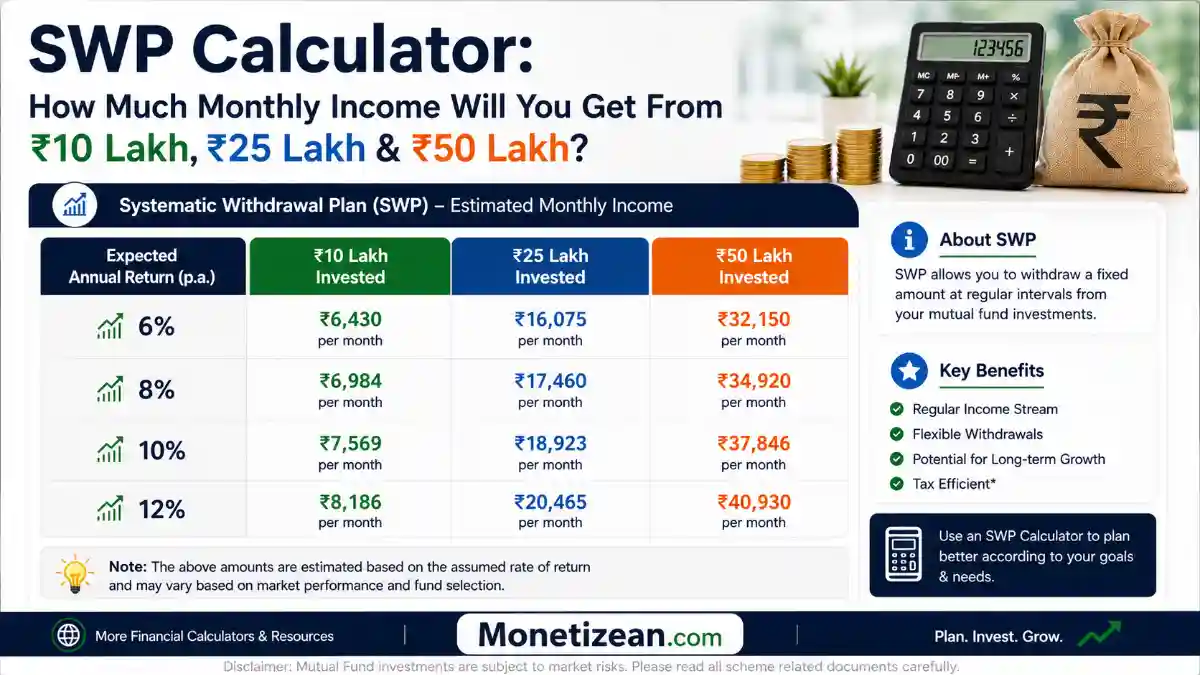
A Systematic Withdrawal Plan (SWP) lets you turn a mutual fund lump sum into a monthly paycheque — but the amount you can safely withdraw depends on your corpus size, the withdrawal rate you choose, and how the market behaves while you’re withdrawing. Below, we break down exactly how much monthly income a ₹10 Lakh, ₹25 Lakh, and ₹50 Lakh corpus can generate, how long that money will last, and what it means for your taxes under the current capital gains rules.
Quick Answer — Monthly Income at a 8% Annual Withdrawal Rate
- ₹10 Lakh corpus → approx. ₹6,667/month (₹80,000/year)
- ₹25 Lakh corpus → approx. ₹16,667/month (₹2,00,000/year)
- ₹50 Lakh corpus → approx. ₹33,333/month (₹4,00,000/year)
These figures assume a fixed annual withdrawal rate split into 12 monthly instalments, before factoring in fund growth or tax. Scroll down for the full calculator and corpus-by-corpus breakdown.
What Is an SWP and How Does It Generate Monthly Income?
A Systematic Withdrawal Plan (SWP) is a facility offered by mutual funds that allows you to redeem a fixed amount — or a fixed number of units — from your investment at regular intervals, typically monthly. Instead of withdrawing your entire corpus at once, you instruct the fund house to sell a small portion of your units every month and credit the proceeds to your bank account.
The remaining corpus stays invested and continues to earn returns, which is what makes SWP fundamentally different from simply keeping cash in a savings account. If your withdrawal rate is lower than your fund’s long-term return, your corpus can theoretically last indefinitely — or even grow. If it’s higher, the corpus depletes over time, and the speed of depletion depends heavily on market sequencing (the order in which good and bad years occur).
The two numbers that matter most in any SWP are the withdrawal rate (withdrawal as a % of corpus per year) and the expected post-tax return of the underlying fund. Everything else — monthly income, corpus longevity, tax outgo — is derived from these two inputs.
₹10 Lakh Corpus: Monthly Income Breakdown
A ₹10 Lakh corpus is often a starting point for retirees supplementing pension income, or for investors testing the SWP route before committing larger sums. Here’s what different withdrawal rates translate to:
| Annual Withdrawal Rate | Annual Income | Monthly Income | Sustainability (at 10% expected return) |
|---|---|---|---|
| 4% | ₹40,000 | ₹3,333 | Corpus grows over time |
| 6% | ₹60,000 | ₹5,000 | Corpus grows modestly |
| 8% | ₹80,000 | ₹6,667 | Roughly stable, minor growth |
| 10% | ₹1,00,000 | ₹8,333 | Broadly stable (rate ≈ return) |
| 12% | ₹1,20,000 | ₹10,000 | Corpus depletes gradually |
| 15% | ₹1,50,000 | ₹12,500 | Corpus depletes faster (~12-15 yrs) |
Who is ₹10 Lakh SWP suitable for?
Realistic monthly range₹3,300 – ₹8,300
Best use caseSupplementary income
Suggested fund typeHybrid / Conservative
At this corpus size, SWP works best as a top-up to an existing pension, rental income, or part-time earnings rather than a standalone retirement income source. A monthly withdrawal in the ₹5,000–₹8,000 range (6-10% annual rate) is generally considered a moderate, more sustainable approach for a ₹10 Lakh corpus invested in a balanced or conservative hybrid fund.
₹25 Lakh Corpus: Monthly Income Breakdown
₹25 Lakh is a common corpus size for investors who’ve accumulated savings through EPF withdrawal, gratuity, or the sale of an asset, and want a structured monthly payout while keeping the bulk of the money invested.
| Annual Withdrawal Rate | Annual Income | Monthly Income | Sustainability (at 10% expected return) |
|---|---|---|---|
| 4% | ₹1,00,000 | ₹8,333 | Corpus grows over time |
| 6% | ₹1,50,000 | ₹12,500 | Corpus grows modestly |
| 8% | ₹2,00,000 | ₹16,667 | Roughly stable, minor growth |
| 10% | ₹2,50,000 | ₹20,833 | Broadly stable (rate ≈ return) |
| 12% | ₹3,00,000 | ₹25,000 | Corpus depletes gradually |
| 15% | ₹3,75,000 | ₹31,250 | Corpus depletes faster (~12-15 yrs) |
Who is ₹25 Lakh SWP suitable for?
Realistic monthly range₹8,300 – ₹20,800
Best use casePartial retirement income
Suggested fund typeHybrid / Large-cap equity
A ₹25 Lakh corpus can realistically cover a significant portion of monthly household expenses for a single retiree in a smaller city when combined with other income sources like Senior Citizen Savings Scheme (SCSS) interest or a small pension. At an 8% withdrawal rate (₹16,667/month), the corpus has a reasonable chance of keeping pace with a moderately-aggressive hybrid fund’s long-term returns, though this is never guaranteed and depends on market performance during the withdrawal period.
₹50 Lakh Corpus: Monthly Income Breakdown
₹50 Lakh is frequently cited as a benchmark “retirement-ready” corpus for individuals in Tier-2 cities, and increasingly common among salaried professionals who’ve consolidated EPF, NPS partial withdrawals, and personal mutual fund investments.
| Annual Withdrawal Rate | Annual Income | Monthly Income | Sustainability (at 10% expected return) |
|---|---|---|---|
| 4% | ₹2,00,000 | ₹16,667 | Corpus grows over time |
| 6% | ₹3,00,000 | ₹25,000 | Corpus grows modestly |
| 8% | ₹4,00,000 | ₹33,333 | Roughly stable, minor growth |
| 10% | ₹5,00,000 | ₹41,667 | Broadly stable (rate ≈ return) |
| 12% | ₹6,00,000 | ₹50,000 | Corpus depletes gradually |
| 15% | ₹7,50,000 | ₹62,500 | Corpus depletes faster (~12-15 yrs) |
Who is ₹50 Lakh SWP suitable for?
Realistic monthly range₹16,700 – ₹41,700
Best use casePrimary retirement income
Suggested fund typeDiversified equity / Hybrid
At ₹50 Lakh, an SWP can function as a primary income stream for many households, particularly outside major metros. A 6-8% withdrawal rate (₹25,000-₹33,333/month) is often discussed as a “moderate” zone — historically, withdrawal rates in this band have had a reasonable chance of preserving the corpus over 15-20 year periods in diversified equity or hybrid funds, though past performance is not indicative of future results and every market cycle is different.
Choosing the Right Withdrawal Rate
The single biggest decision in setting up an SWP isn’t the fund you choose — it’s the withdrawal rate. A commonly referenced starting point internationally is the “4% rule,” derived from US retirement research, but Indian retirees often work with a wider range because of different tax treatment, inflation patterns, and the availability of debt instruments like SCSS, PMVVY, and RBI Floating Rate Bonds that can supplement an SWP.
| Withdrawal Rate | Risk Zone | What it implies |
|---|---|---|
| Below 6% | Conservative | High likelihood corpus outlasts withdrawal period; useful if leaving a legacy corpus matters |
| 6% – 9% | Moderate | Commonly used range; corpus longevity depends heavily on fund performance and sequencing |
| 9% – 12% | Aggressive | Corpus likely depletes within 12-20 years even with decent returns |
| Above 12% | High depletion risk | Corpus often exhausted within 8-12 years; suitable only for short-term needs |
Sequence-of-Returns Risk
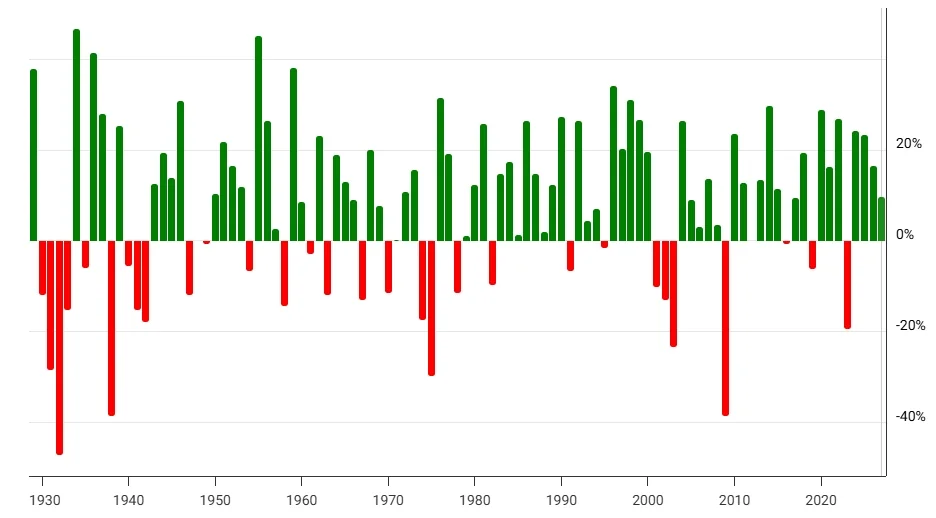
Two SWPs with identical average annual returns can have very different outcomes depending on when the bad years occur. A market crash in the first few years of an SWP is far more damaging than the same crash occurring later, because withdrawals during a downturn force you to sell more units at lower prices, permanently reducing the corpus’s recovery potential. This is why flat-return calculators (including the one above) should be treated as illustrative, not predictive.
SWP Taxation Rules (FY 2026-27)
Every SWP withdrawal is treated as a partial redemption of units, which triggers capital gains tax on the gain portion (not the entire withdrawal amount). The tax treatment depends on the fund category and holding period.
| Fund Type | Holding Period | Tax Treatment |
|---|---|---|
| Equity-oriented funds (>65% equity) | > 12 months (LTCG) | 12.5% on gains exceeding ₹1.25 Lakh per financial year |
| Equity-oriented funds | ≤ 12 months (STCG) | 20% on the gain portion |
| Debt-oriented funds | Any holding period | Gains added to income, taxed at applicable slab rate |
| Hybrid funds (equity-oriented, >65% equity) | Follows equity fund rules | As per equity fund LTCG/STCG above |
Why SWP Can Be More Tax-Efficient Than FD Interest
Unlike fixed deposit interest, which is fully taxable at your slab rate every year, an SWP withdrawal is only partially taxable — only the capital gains component embedded in each withdrawal is taxed, not the entire amount. For equity funds, the ₹1.25 Lakh annual LTCG exemption can mean a substantial portion of withdrawals from a moderately-sized SWP face zero or reduced tax in a given year, depending on the proportion of gains versus principal in each redemption.
Common SWP Mistakes to Avoid
1. Setting the withdrawal rate based on FD interest habits
Many first-time SWP investors mentally anchor their withdrawal amount to what they’d get from an FD (typically 6-7%), without realizing that unlike FD interest, SWP withdrawals dip into the principal when the fund’s return in a given period is lower than the withdrawal rate.
2. Choosing a high-volatility fund for the entire corpus
Putting 100% of an SWP corpus into a small-cap or sectoral fund increases the sequence-of-returns risk significantly. A hybrid or large-cap-oriented approach is more commonly used for SWP corpora that need to fund regular withdrawals.
3. Not reviewing the withdrawal rate periodically
An 8% withdrawal rate that looked sustainable when the fund was at an all-time high can become a 12-15% effective rate after a 30% market correction, simply because the corpus value has fallen while the withdrawal amount stayed fixed. Annual reviews help catch this drift early.
4. Ignoring exit load and minimum balance requirements
Some funds levy an exit load on units redeemed within a specified period (often 1 year), and most SWP facilities require a minimum balance to remain in the folio. Both can erode returns if not accounted for when setting up the SWP.
Frequently Asked Questions
What is a good SWP withdrawal rate for retirement in India?
There’s no single “correct” rate, but withdrawal rates in the 6-8% annual range are commonly discussed as moderate starting points for diversified equity or hybrid fund corpora, balancing income needs against the risk of depleting the corpus too quickly. Conservative investors who prioritize corpus preservation often choose 4-6%, while those comfortable with higher depletion risk in exchange for higher current income may go to 10% or beyond. The right number depends on your age, other income sources, life expectancy assumptions, and risk tolerance — ideally discussed with a SEBI-registered investment adviser.
Is SWP better than a Fixed Deposit for monthly income?
SWP and FDs serve different purposes. FDs offer fixed, guaranteed interest with no market risk, making them suitable for capital that absolutely cannot fluctuate. SWPs offer the potential for the corpus to grow alongside withdrawals and are generally more tax-efficient since only the gains portion of each withdrawal is taxed, but they carry market risk — both the income amount’s real value and the corpus’s longevity can vary with market performance. Many financial planners suggest a combination of both rather than choosing exclusively one.
How much corpus do I need for ₹50,000 monthly income via SWP?
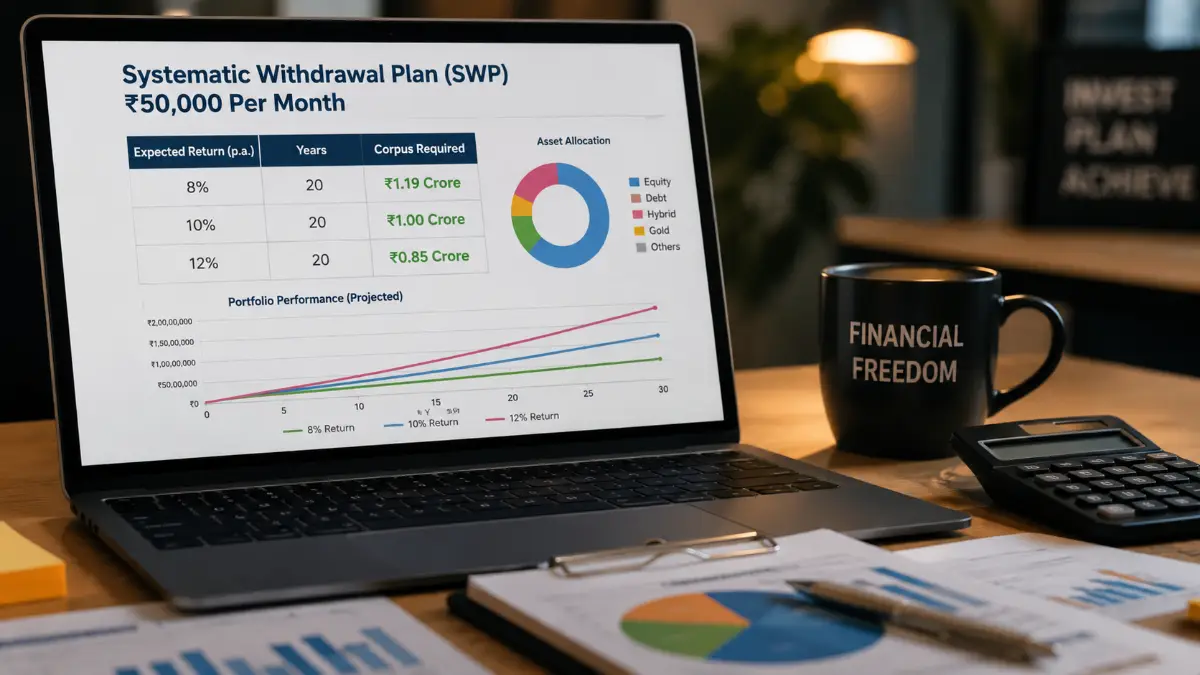
At an 8% annual withdrawal rate, generating ₹50,000/month (₹6,00,000/year) would require a corpus of approximately ₹75 Lakh. At a more conservative 6% withdrawal rate, the required corpus rises to approximately ₹1 Crore. At a higher 10% withdrawal rate, around ₹60 Lakh would be needed, though this comes with greater depletion risk over the long term.
Can I stop or modify my SWP anytime?
Yes. SWPs are generally flexible — you can pause, modify the withdrawal amount or frequency, or cancel the SWP entirely by submitting a request to the fund house (often available online or via the fund’s app). There’s typically no penalty for stopping an SWP, though any applicable exit load on units redeemed within the fund’s specified period would still apply to those specific units.
Does SWP withdrawal affect my mutual fund’s NAV or units?
Each SWP withdrawal redeems a certain number of units (calculated by dividing the withdrawal amount by that day’s NAV) and reduces your total unit holding accordingly. It does not affect the NAV itself — NAV is determined by the fund’s overall portfolio value divided by total outstanding units across all investors, not by any individual investor’s transactions.
Is SWP income taxable every month or only at year-end?
Capital gains from each SWP redemption are technically realized at the time of that redemption, but tax is calculated and paid on an annual basis when filing your income tax return for that financial year — there’s no monthly TDS deduction for resident individuals on equity or debt mutual fund SWP redemptions in most cases. It’s advisable to track the gain component of each withdrawal through the fund house’s statements or a consolidated capital gains statement for accurate annual tax filing.